The Woman of the Eucharist
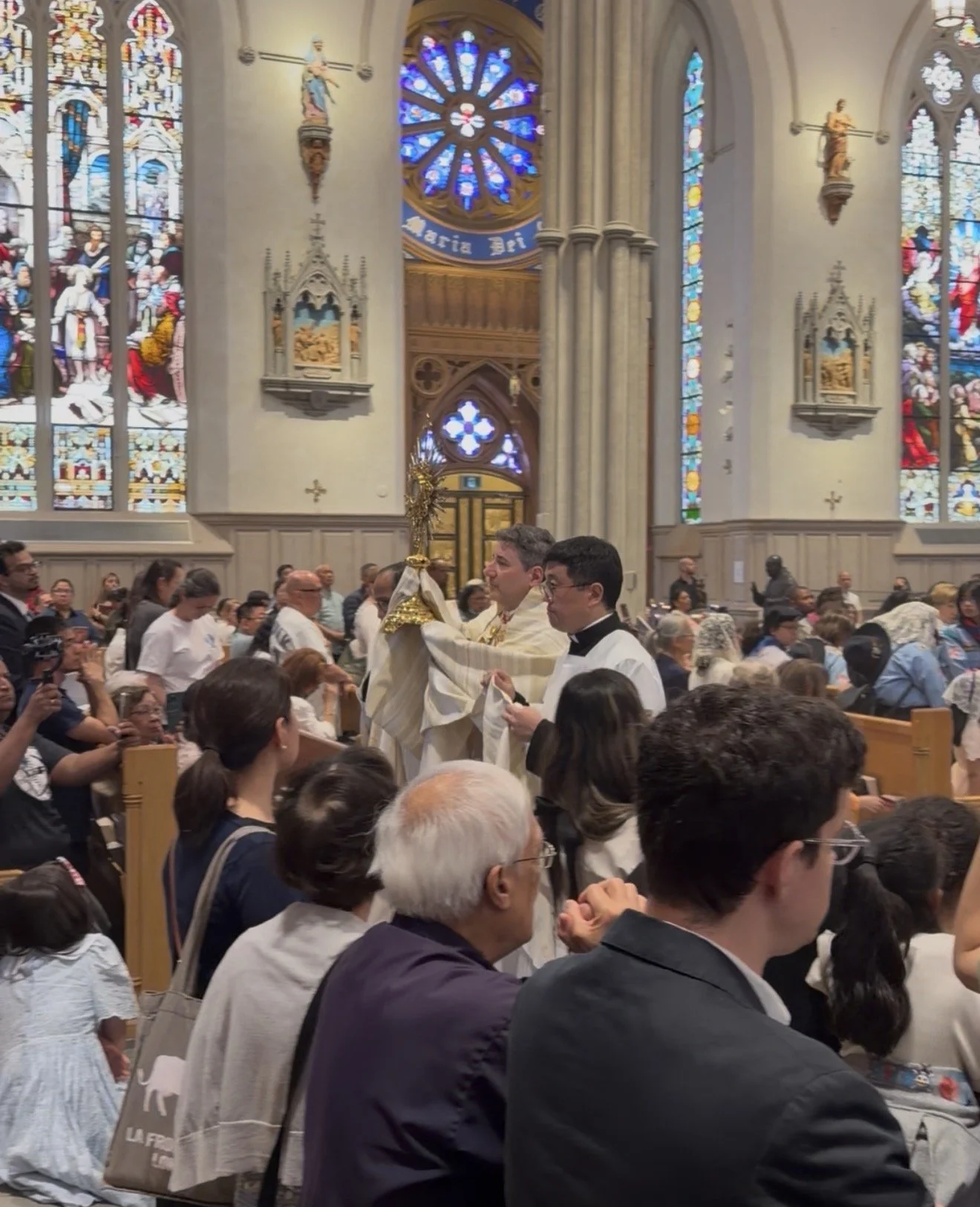
In his homily at Sunday’s Corpus Christi Mass, Cardinal Francis Leo spoke of the Woman of the Eucharist.
Mary.
He drew a line I had never heard drawn that way before. The words of Jesus at the Last Supper — “Do this in memory of me” — echoing the words of the Virgin at Cana:
Do whatever he tells you.
That sentence stayed with me.
Not because it was clever.
Because it was severe.
And because, for Cardinal Leo, it is not decorative language.
It is his motto.
Quodcumque Dixerit Facite.
Do whatever he tells you.
The Archdiocese of Toronto’s own biography makes clear that this is not a passing Marian flourish. Cardinal Leo holds a doctorate in systematic theology with a specialization in Mariology. He is president and founding member of the Canadian Mariological Society. His episcopal motto is drawn directly from John 2:5, from Mary’s words at Cana.
So when Cardinal Leo speaks of the Woman of the Eucharist, he is not improvising piety.
He is speaking from the centre of his priesthood, his scholarship, his episcopacy, and his pastoral imagination.
Mary does not explain Christ. She does not manage Christ. She does not soften him for polite company. She does not turn obedience into mood, brand, therapy, or aesthetic.
She points.
Do whatever he tells you.
That is the Church at her most honest.
In a cathedral packed from basement to rafters, with thousands more spilling out into the street, the Cardinal spoke of Mary not as religious decoration, not as sentimental motherhood, not as a soft blue statue placed safely beside the real action.
He spoke of her as the Woman of the Eucharist.
The one who knows that Christ is not an idea to be admired.
He is a Lord to be obeyed.
And then we left the cathedral.
The Marian statue stood before us on the steps. The Blessed Sacrament was adored in procession. The Cardinal carried the monstrance through the doors of St. Michael’s and out beyond the gates, holding the presence of God before the city.
Inside became outside.
Sanctuary became street.
Prayer became procession.
The Body of Christ did not remain safely enclosed behind stone, music, incense, vestments, and stained glass.
He went outside.
That matters to me.
Years ago, in my own confession, I wrote that there were very few theological rituals and beliefs I would have stood at the last defending.
God’s love for humanity.
Jesus’ sacrifice as ultimate love.
The altar needing to become a table of real-life food.
Confession as necessary for a people of faith.
I still believe that.
Maybe more now than I did then.
Because I have spent too much of my life watching institutions keep Christ indoors while people bleed outside the gates. I have seen Christian language used to decorate cowardice, manage scandal, rush forgiveness, protect power, and call it peace.
But this was different.
This was not Christ hidden behind institutional anxiety.
This was Christ carried into Toronto.
Not metaphorically.
Not symbolically.
Not as brand language.
Christ.
Real.
Lifted up in the monstrance for the city to see.
It was not Madrid, where 1.2 million gathered with the Pope for Corpus Christi.
This was Toronto.
One of the most multicultural cities in the world. A city of migrants, refugees, strivers, survivors, believers, workers, families, priests, sisters, old women with rosaries, children trying to see over the crowd, and men like me who have taken the long way home.
And the man carrying the monstrance was himself a son of migration.
Francis Leo was born in Montreal to Italian immigrant parents, Francesco Leo and Rosa Valente. He was formed in Montreal, sent to Rome, served in the diplomatic life of the Holy See, returned to Canada, and was eventually sent to Toronto — this impossible, beautiful, exhausted, multilingual city — to carry Christ into the street.
That matters.
The Eucharist was not being carried above the city as a symbol of conquest.
It was being carried through the city as the presence of the One who comes to dwell among us.
The altar became a table of real-life food.
Not an abstraction.
Not an argument.
Food for pilgrims.
Food for sinners.
Food for the wounded.
Food for the city.
I sat among pilgrims from everywhere.
And I would be lying if I said I was not humbled.
I was humbled by the reverence.
I was humbled by the scale.
I was humbled by the silence inside the noise.
I was humbled because I did not feel like a spectator. I felt like the prodigal who had been seen before he reached the porch.
That is the part I cannot shake.
The Father does not wait at the door of the house, arms crossed, dignity intact, waiting for the son to clean himself up enough to be received.
The Father runs down the road.
Grace comes outside the gates.
That is what Corpus Christi looked like to me.
The Father running.
The Son lifted up.
The Mother pointing.
Do whatever he tells you.
I accepted Cardinal Leo’s gracious invitation to behold the Body of Christ.
I came as a man with history. A man with ruins. A man who has crossed the Tiber in both directions and learned that not every road away from home is freedom. A man who knows what it is to mistake movement for conversion and pain for wisdom.
But there, in the street, beside Mary, beneath the monstrance, surrounded by strangers, I was given something simpler than argument.
Christ is real.
The Body of Christ was lifted up for Toronto to see.
And the Woman of the Eucharist stood where she has always stood, refusing sentiment, refusing spectacle, refusing control, saying the only thing the Church finally needs to hear:
Do whatever he tells you.
I was humbled by the presence of Christ in the danger of the street.