Twenty-Five Months
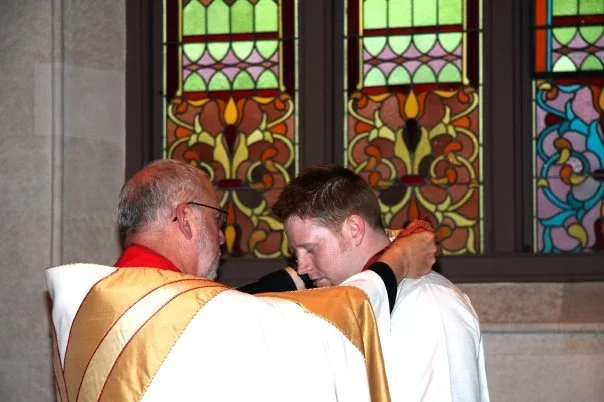
Twenty-five months after I became an Anglican, a bishop I understood to be deeply compromised by alcohol laid hands on me and called me a priest.
Read that sentence again.
Twenty-five months.
A Glasgow-born Catholic. A boy baptized into Rome in Scotland. A son of a woman whose maiden name was O’Neil, carrying Irish Catholic memory in my blood long before I had the language to understand what that meant.
Twenty-five months after crossing the Tiber in the wrong direction, Anglicanism dressed me up, prayed over me, put hands on my head, invoked the Holy Spirit, and told the world I had become a priest.
I believed it.
That part matters.
I was not mocking the altar. I was not playing at holiness. I was not using the Church as theatre, even though, God help me, the collar often felt like a costume. In my memoir, I wrote that the first time Rory’s mother saw me in my collar, the week before ordination, she laughed because it looked like Halloween.
She was right.
It felt like Halloween.
I wanted to want it. I wanted to be the kind of man who deserved it. I wanted the vestments to make me whole. I wanted the Church to name me into stability. I wanted sacrament to do what therapy, family, honesty, sobriety, and time had not yet done.
But sincerity is not validity.
Need is not vocation.
Charisma is not formation.
Institutional affirmation is not apostolic succession.
June 4 was the day I was ordained in 2008.
In the Anglican commemorations, June 4 is the day of John XXIII — Bishop of Rome, reformer, ecumenist, the pope who opened windows in rooms stale with fear.
I knew Anglicanism honoured him.
At least officially.
But on my ordination day, the bishops anticipated the June 5 commemoration of St. Boniface instead.
Maybe it meant nothing.
Maybe it was liturgical housekeeping.
Or maybe, looking back, it says more than anyone in that room intended.
Not John XXIII.
Not Rome.
Not reform as return.
Not the Catholic imagination standing quietly in the room asking Anglicanism what exactly it thought it was.
Something else.
Something safer.
Something Anglicanism could manage.
A missionary bishop. A cleaner symbol. A less dangerous story.
But my story was not clean.
I was a wounded young Catholic man with O’Neil blood, family fracture, religious shame, addiction history, sexual confusion, clerical ambition, and a desperate need to be seen as redeemed.
And Anglicanism did what Anglicanism so often does.
It made the trauma useful.
It called the wound a gift.
It mistook survival instincts for priestly maturity.
It mistook public performance for sacramental readiness.
It mistook my hunger for home as evidence that I had found one.
I no longer believe Anglican orders are valid.
There it is.
Not as a cheap shot. Not as convert theatre. Not because Rome is pure.
Rome is not pure.
But sacraments are not vibes. Priesthood is not therapeutic belonging. Apostolicity is not beautiful language, progressive politics, tasteful liturgy, or the capacity to make wounded men feel temporarily useful.
That is where June 4 hurts.
Not because I want Anglican orders back.
I do not.
It hurts because I gave myself to something I now believe could not give me what it claimed.
Grace still came.
Of course grace came.
Grace came in hospital rooms, funerals, sermons, coffee hours, dying beds, Pride parades, and broken people finding somewhere to rest.
God is merciful.
But mercy is not permission to lie.
Twenty-five months after I became an Anglican, they called me a priest.
A Glasgow-born Catholic.
An O’Neil.
A son of Rome wandering through Canterbury wearing borrowed clothes.
And maybe the hardest mercy of my life is this:
I finally took them off.