We Are Marshall and the Gospel According to Byron Leftwich
There is a scene at the end of We Are Marshall that almost everyone remembers.
Not the plane crash.
Not the speeches.
Not even Jack Lengyel rebuilding a shattered football program.
What people remember is Byron Leftwich being carried.
Marshall’s story began in tragedy. In 1970, seventy-five people connected to the football program died when Southern Airways Flight 932 crashed near Huntington, West Virginia. The school, the city, and the team had to decide whether they would survive at all.
Thirty-two years later, Leftwich became the living embodiment of what Marshall had learned.
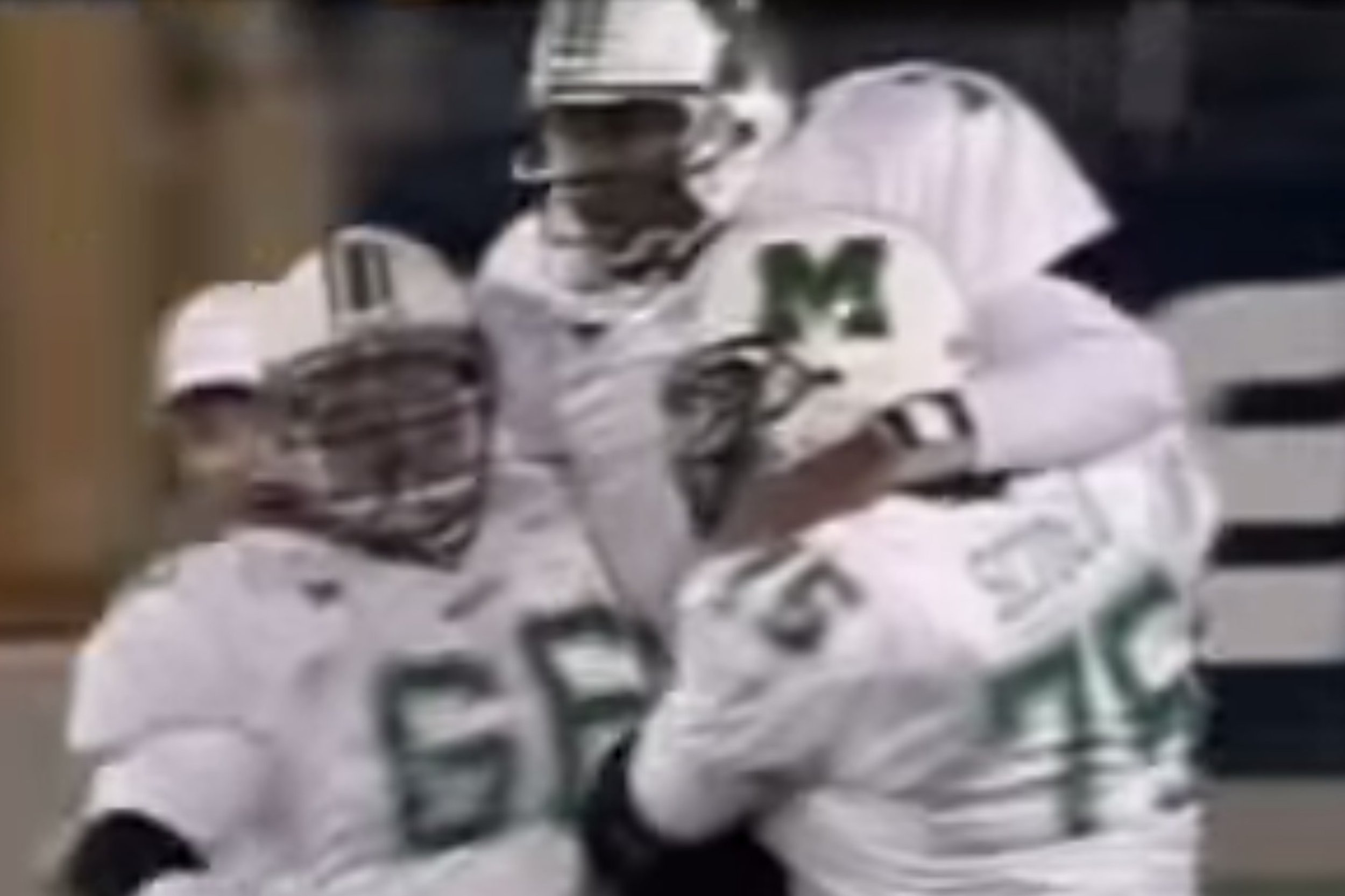
Against Akron in 2002, he broke his shin. Not a bruise. Not a sprain. A broken leg. Yet he stayed in the game. Between plays, his offensive linemen literally carried him down the field because he could no longer walk back to the huddle on his own.
Marshall lost that game.
That matters.
Because we live in a culture obsessed with victories.
We celebrate winners. We build statues to champions. We tell stories about people who conquered, dominated, and overcame.
But the reason people still talk about Byron Leftwich is not because he won.
It is because he refused to quit.
That distinction becomes more important the older I get.
When I first watched We Are Marshall, I thought it was a football movie.
Now I think it is a movie about grief.
About communities that bury their dead and somehow keep going.
About fathers who keep showing up.
About people who discover that courage often looks less like conquering and more like enduring.
The older version of me no longer identifies with the quarterback throwing touchdowns.
I identify with the quarterback being carried.
There is a lie hidden inside much of modern culture: that strength means independence.
Marshall teaches the opposite.
The entire point of the Leftwich moment is that he could not do it alone.
His teammates carried him because they loved him.
And he kept throwing because he loved them.
That is not weakness.
That is covenant.
That is community.
That is what human beings were made for.
The truth is that most of us eventually become Byron Leftwich.
Not on a football field, but somewhere in life.
A diagnosis.
A betrayal.
A season of depression.
A fractured family.
A dream that doesn’t survive contact with reality.
Something eventually breaks.
And then the question is no longer whether you are strong.
The question is whether anyone is still willing to carry you toward the next play.
That is why the story endures.
The plane crash did not get the final word.
The losing seasons did not get the final word.
The broken leg did not get the final word.
Despair did not get the final word.
Neither does your worst day.
“We Are Marshall” was never just a chant.
It was a declaration.
We are still here.
We are wounded.
We are carrying each other.
And we’re lining up for the next play anyway.