Exilic Hope
“It’s not the wilderness if it isn’t dangerous. In the wilderness, there is always something that can kill you.” – Barbara Brown Taylor
Jeremiah could certainly be seen to be a weaker prophet, no?
These are God’s chosen people he addresses. The elect, the pardoned, the anointed; those whom God promised generation upon generation to inherit the land where milk and honey would continuously flow. A chosen people who had known the depth of suffering in slavery, and the fulfilled promise of an even deeper joy. But the prophet who seems to proclaim more “doom and gloom” than almost any other in the canon of scripture, Jeremiah does not speak from a place of privilege or power, but instead from the devastating reality that he (and his people) may never return home.
The people who had been delivered from slavery in Egypt were now exiles from the Promised Land.
Listening to the speakers at the Evolving Faith Conference in Denver, Colorado, this week, I couldn’t help but find myself enamoured with this Sunday’s Old Testament lection. The gathering was everything –and nothing– I expected. It was rich with emotion and conviction and stripped of most traditional sign and symbol. It was certainly rooted in a common tradition (often without traditional language), but it was crystal clear, these were people who felt they didn’t belong. For the most part, attendants and speakers were disenfranchised Christians. LGBTQ, divorced, abused, overlooked, neglected, and fractured people of God. It was the most organized gathering of Christian misfits that I have ever seen, and it felt sincerely like there was more than enough room.
I struggle deeply with my own place of privilege in this world, and I did while gathered amongst this group. On the surface, I am no more than a white, straight, north American male, who graduated high school from a family of means and didn’t pay a cent for either of my first two university degrees. For all intents, purposes and appearances, I come from a land of milk and honey where needs were provided for in full.
However, as any of us who have found ourselves in the wilderness know: Much can be lost, stability can be wrenched away, and suddenly nothing is how it was “supposed to be”.
The arc of the biblical narrative throughout the entire Canon of the Hebrew Bible plays some tricks with the new and first-time reader (as well as many with seminary degrees). As twenty-first century quick-draw verse-slingers, we might struggle to grasp the harsh narrative, and overwhelming reality, this first generation of exiled people would have known. Separated from family, and community and culture – they would have felt like a part of them had been stripped away from the inside out – leaving a shell of what was there before.
This first generation were likely the ones who held out the deepest hope – that God would one day deliver them. That they would be returned to their homes; that they would be reunited with their families; that they would be reconciled with their God.
These were God’s chosen people. How could this be their end?
But I wonder if this isn’t the story that every generation of Christian has to wrestle with. How to live in the reality of “almost but not yet”. How to live with a knowledge of a promise that the world just doesn’t seem to get.
The apocalyptic “end-of-days” prophecies that pop up every few years certainly show how the “prophetic” voice of impending doom can cause many siblings (and denominations) to believe the voice of the prophet is for their time. Which, don’t get me wrong, it is – just perhaps not the way we might choose to jump in. Even the earliest Christians (perhaps St Paul included) seem to believe that generations will not pass before the wrongs of this world will be made right by God.
Jeremiah addresses a people in exile, and instead of telling them to “hold out hope”, to “stay the course” or to “suffer for the sake of promises that will be fulfilled”, he tells God’s chosen to live amongst the Babylonians; to break bread with them, to share space with them, and to take comfort in the land in which they had found themselves captive.
I grew up in a generation that was fascinated with prophecy. From the Mayan calendar to the skewed foretellings of Nostradamus. But Judeo-Christian prophecy, the words of the prophets falling from the line of Abraham, Isaac, and Jacob, are not simply a magic foretelling of the future, but rather a divine proclamation of what God has already begun.
There is no immediate solution for these exiled Hebrews in Babylon, no free ride or shuttle bus headed towards the Dead Sea. They were exiled people, resident in a foreign land, and the prophet comes before them, saying, “Wake up Exiles! God is at work, right here!”
Break bread with your captures. Serve those who keep you. Make a home in the wilderness of this foreign world. Not because this is God’s deepest desire for you to be happy or fulfilled or brimming with joy on this particular day – but because in the scarcity of this foreign land where milk nor honey flow, “God is at work, right here!”
The prophet calls a people who have every reason to believe they have been abandoned by God, and tells them they are not going home to find comfort, because they have work to do in this foreign land. His instructions are simple and plain; to eat and drink, to break bread and to live as faithful people. A big request for those who knew they had no Temple and were not sure if they even had a God.
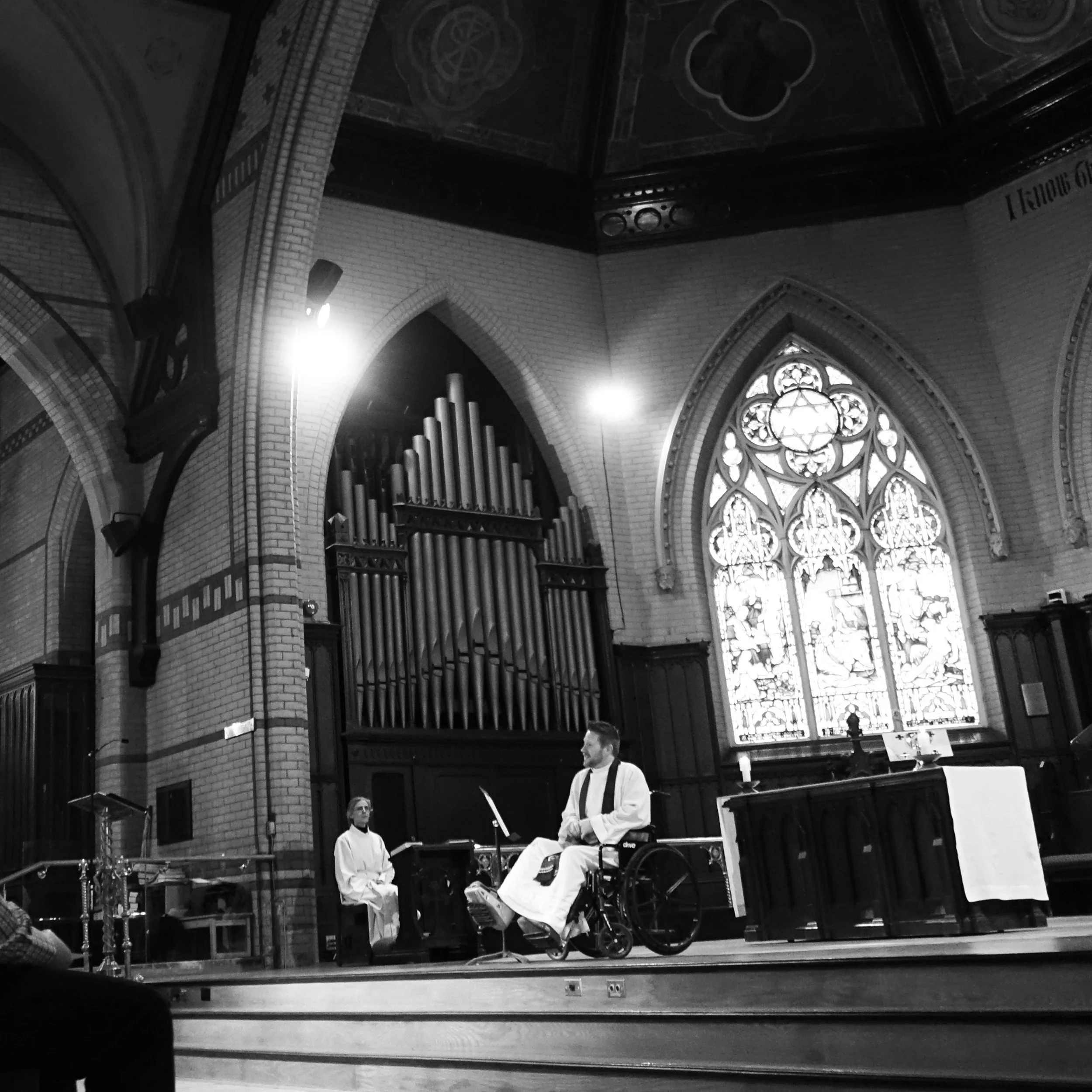
I sat in church crying last week; almost through the entire body of the sermon. Not because I didn’t like what the preacher had to say, but because I knew I had been given a new role in the assembly. No longer was I the priest who held the broken community together in the Celebration of the Eucharist, or the preacher proclaiming the word. But, living in a foreign land, having been stripped of a part of me that has me feeling like a shell of myself, I heard the preacher tell me that God's work just isn’t done.
Make a house here. Break bread with you neighbours. Love one another with sacrificial love. Proclaim the good news of God’s salvation from that very pew where you just stuck your bum.
I think I would have thought Jeremiah was a real jackass. Telling me what God’s doing for me and with me and in me, when it sure as hell seems like God left me behind long ago. Why shouldn’t I just take my stuff and turn my back; dust off my feet and abandon God?
But then I hear the words of the prophet, not foretelling the future, or promising salvation or deliverance or a staff that will spread the Red Sea. Just a simple command to live as God’s faithful people, without any of the promises or comforts from a life that is no longer.
Jeremiah could certainly be seen a weaker prophet in his pandering to the enemy, no? Relinquishing control. Submission to their dominance. Suspension of their heartache and rage.
Maybe at first glance, but not so much at the second and third.
It is a harsh reality to face for those of us who don’t want to live in slavery or exile or in the liminal space between death on Friday and resurrection at the empty tomb. It seems an unfair sentence for those who so desperately want to proclaim the love of God in an assembly who responds, “Amen!”
But, as some prophetic words do in scripture, the prophet gives a most unsatisfying answer to a people who yearn for hope.
You shall not be delivered back to a life which is now dead. But right where you are, amongst foreigners and misfits, exiles and capturers, victims and perpetrators, I will make you a beacon of hope on the land where your tears continue to fall.
Amen.
#EvolvingFaith19 #Exile #Hope