In Another Country
A few nights before leaving Canada, I watched England play Mexico at the Harp Tavern in Toronto.
Throughout the World Cup, I had brought Croatian, Ghanaian and Panamanian shirts and other items into the pub—something for every country drawn against England.
I considered it a modest contribution to multiculturalism.
For the Mexico match, I carried an authentic sombrero I had bought in Playa del Carmen.
England were leading at the Azteca when Jarell Quansah was sent off early in the second half. I raised the sombrero and yelled—twice, and loudly enough for the room to hear:
“Send him hame tae think again!”
Quansah’s red card left England playing with ten men for the rest of the match, although they still held on to win 3–2.
An Englishman farther down the bar turned towards me.
“We’re in another country,” he shouted.
I did not take the bait.
For one thing, he was right.
We were in Canada, watching England play Mexico, while I stood in a Toronto pub waving a Mexican hat and quoting Flower of Scotland.
There was enough happening already.
But the line stayed with me.
“We’re in another country.”
That has been most of my life: Scottish in another country. Supporting Scotland in another country. Supporting whoever England happened to be playing in another country.
Tonight, I will not be in another country.
I will be in Scotland when England play Argentina for a place in the World Cup final.
Keir Starmer has encouraged Scottish supporters to get behind England in the name of unity.
I admire the optimism.
Scotland will be supporting Argentina.
Not every Scot, obviously. There are decent and reasonable people everywhere. But enough of us that Starmer’s appeal feels less like national leadership and more like a basic misunderstanding of the assignment.
England and Argentina bring their own history.
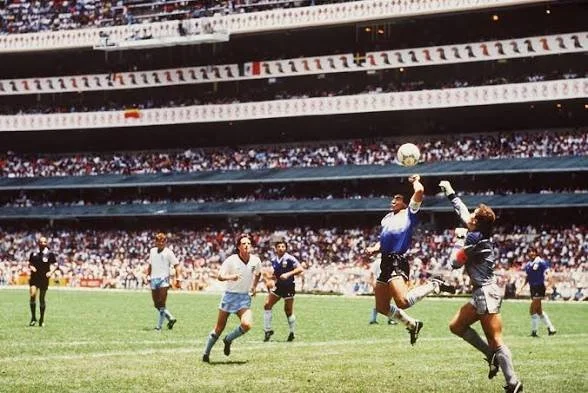
In 1986, four years after the Falklands War, Diego Maradona scored twice against England in the World Cup quarter-final.
The first went in off his hand.
The second came after he collected the ball inside his own half and ran through England to score what became the Goal of the Century.
One was cheating.
The other was genius.
Both were Maradona.
We like people to be simpler than that: hero or villain, saint or sinner, one moment held above an entire life as though it explains the whole person.
I have done that to others.
I have also spent years asking people not to do it to me.
Maradona called the first goal the Hand of God.
It was not.
It was his hand, a missed call and one of football’s greatest acts of nerve.
God was not refereeing.
But football has always borrowed the language of religion because it understands belief, ritual, memory, guilt, forgiveness—and the hope that, this time, history might turn in our favour.
Football is not why I came to Scotland.
But tonight, for once, I will not be Scottish in another country.
I will be in Scotland.
And I will be cheering for the Hand of God.