Tell Them How We Live
A morning with Hamzeh in Dheisheh refugee camp
Editor’s note, August 2, 2026: This is a personal account of a morning in the Dheisheh refugee camp in the West Bank, near Bethlehem, in February 2018. It has been reconstructed from photographs and the account I wrote immediately after the visit. All quotations attributed to Hamzeh are drawn from that original account. This is not a comprehensive history of Israel and Palestine. I am republishing it because I made a promise to share Hamzeh’s story and tell people how his community lived.
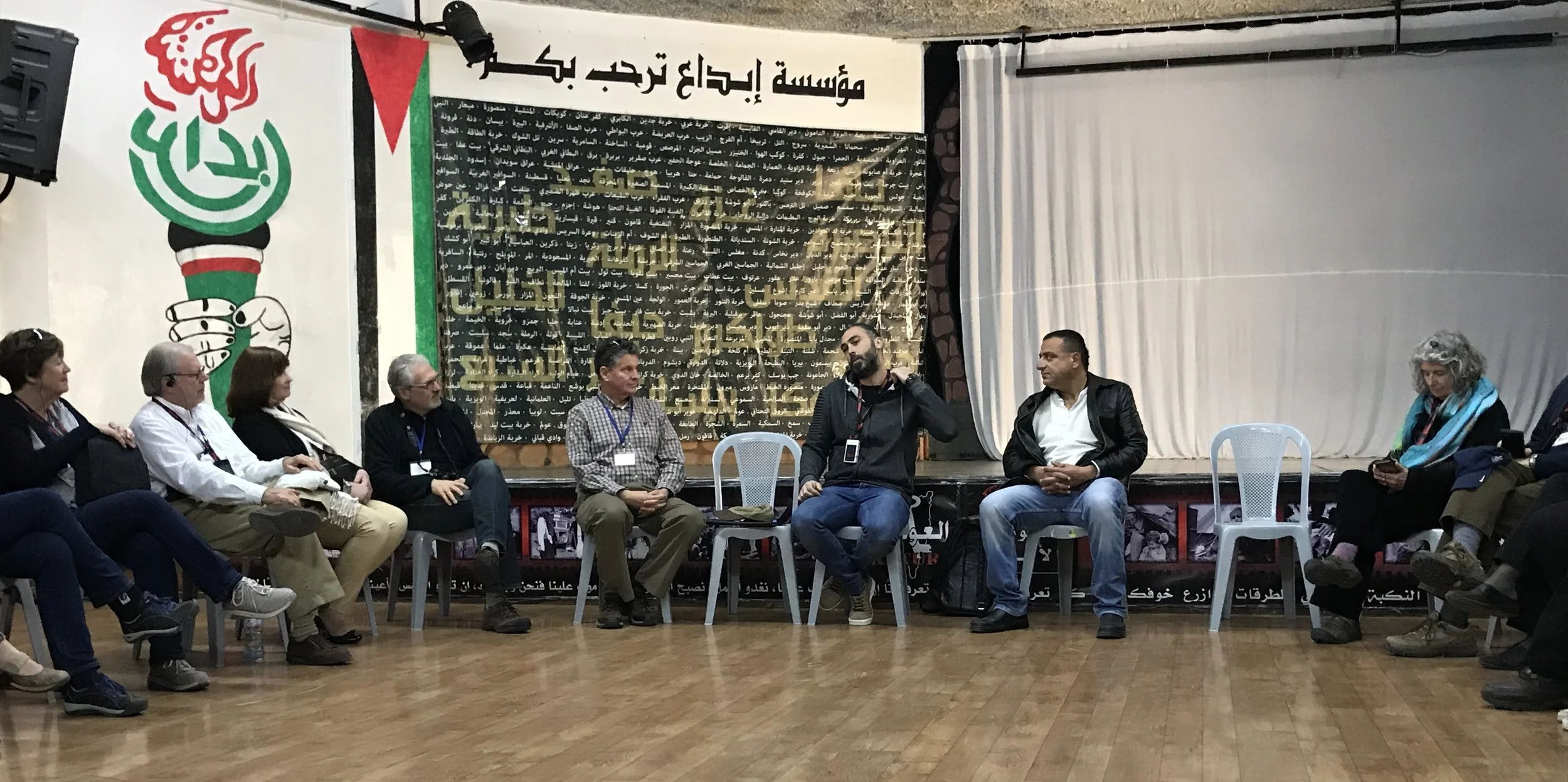
I found Hamzeh again this week.
Not the man himself, but the photographs I took and the words I wrote after he walked us through the Dheisheh refugee camp in February 2018.
There he was inside the Ibdaa Cultural Center, speaking to a room of visitors about the community where he lived and worked. There were the narrow streets, the concrete buildings, the murals and the football trophies.
There were children playing wherever they could find enough room.
Eight years have passed.
The responsibility that came with taking those photographs has not.
We spent the morning with Hamzeh, a Palestinian social worker who had agreed to show us around.
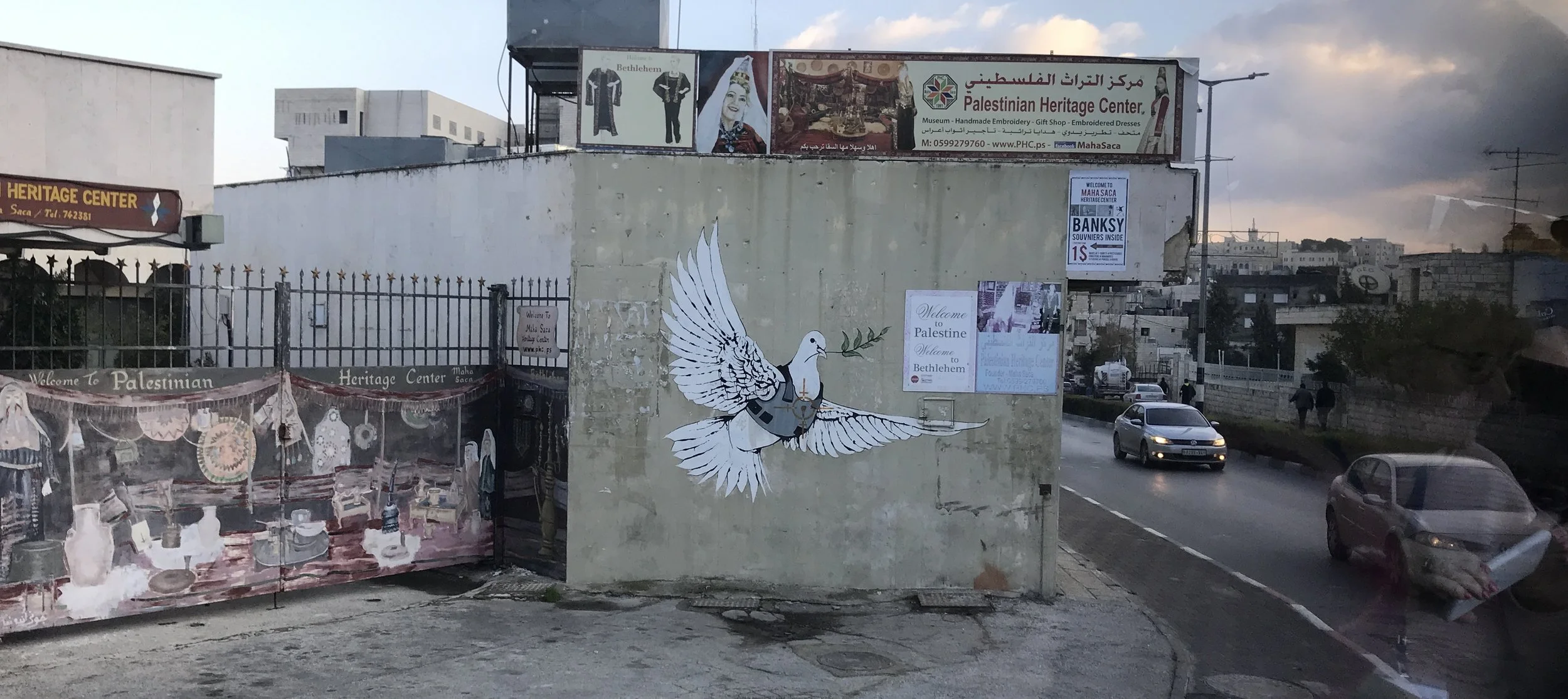
The buildings seemed pressed against one another. Hamzeh told us that water and electricity could not always be relied upon. As we travelled around Bethlehem, walls, checkpoints and watchtowers repeatedly entered the landscape.
But deprivation was not the whole of Dheisheh.
People moved through the streets. Washing hung from balconies. Neighbours stopped to speak. Children appeared in doorways and kicked footballs between the buildings. Art covered the walls.
From a distance, a refugee camp can become an abstraction. A political symbol. A phrase used by governments, journalists and people arguing online.
Dheisheh was a neighbourhood.
People lived there.
Children were growing up there.
Hamzeh was trying to help them grow.
Watching the boys play football, I thought of Rory.
Not because their lives were the same. They were not.
I recognized something familiar in the seriousness of the game. The laughter was familiar too. So was the brief escape offered by a ball and a small piece of open ground.
There was not much space.
They played anyway.
At one point, someone asked Hamzeh whether conditions inside the camp could leave young people vulnerable to recruitment by terrorist organisations or organised crime.
It was the sort of question he had clearly heard before.
He sighed.
“It depends who’s asking,” he said.
Then he described what it meant to grow up beneath a label that other people believed had already been decided for you.
“I am Palestinian; I am a terrorist. The children playing outside are Palestinian; they are terrorists. We have been told who we are. You have been told who we are. Again, and again, and again.”
He was not praising or excusing violence. He was describing the suspicion he believed attached itself to Palestinian identity.
The question was about radicalisation.
Hamzeh heard something else inside it: the assumption that Palestinian children should first be understood through the violence they might one day commit.
His answer did not resolve the question.
It changed its direction.
Before asking what these children might become, he wanted us to consider what many outsiders had already decided they were.
Hamzeh worked as a social worker inside the community.
His response was practical.
Football.
Books.
Art.
Dance.
Education.
Relationships.
Inside the cultural centre were trophies and photographs of teams—evidence that children from Dheisheh had travelled and represented their community beyond the camp.
Listed on paper, those things might sound ordinary.
But ordinary childhood experiences matter when children are repeatedly reduced to symbols, statistics or security concerns.
Hamzeh was not claiming that football could resolve the conflict around them. He was helping to create places where children could read, play, dance and belong.
Places where they could understand themselves through their families, culture and community rather than only through the names assigned to them by strangers.
He was making room for ordinary childhood.
That work stayed with me.
Children inherit more than surnames, customs and family stories. They can also inherit grief, fear, humiliation and conflicts that began long before they were born.
Trauma does not move cleanly from one generation to the next.
Neither does healing.
People can carry pain and cause pain. Sometimes they do both. They can also try, imperfectly and patiently, to alter what might otherwise be passed on.
That was what I saw Hamzeh attempting.
He could not erase the history that had shaped Dheisheh. He could not remove the restrictions that shaped daily life or guarantee the children a different future.
He could show up.
He could help build teams.
He could create space for books, music and dance.
He could insist that the children playing outside were children before they were anything else.
There is a temptation when writing about a place like Dheisheh to make the visitor the centre of the story.
To explain how shocked I was. How moved I felt. What the experience taught me.
But Hamzeh did not need me to discover his humanity.
The children did not require my astonishment in order to become real.
I was a visitor.
I walked through their streets for a morning, took photographs and left.
They remained.
That is the limitation of witness. You enter another person’s reality, carry a small part of it away and return to a life in which you are free not to think about it.
Before leaving, I asked Hamzeh what I could do.
His answer was simple.
Share their stories.
Tell people who they are.
Tell people how they live.
So I wrote about him. I published the photographs.
Then the years passed, as years do, and the piece disappeared beneath newer stories, newer journeys and newer versions of me.
But the promise did not expire.
Much has happened since I took those photographs. The years since have brought terrible violence, displacement, fear and grief to Palestinian and Israeli civilians.
One morning in 2018 cannot explain that history or the fears carried by either community.
It was never meant to.
Recognising Palestinian humanity does not require denying Israeli humanity. No civilian should be made answerable for a government, army or armed group.
This was one morning.
One place.
One man trying to create something decent for children growing up inside a conflict they did not begin.
A photograph does not become meaningless because it is old. A person’s dignity does not become less urgent because the world has moved to another headline.
I remember the boys playing between the buildings.
I remember the trophies inside the cultural centre.
I remember Hamzeh’s exhaustion when he was asked, once again, to explain why Palestinian children should not be presumed dangerous simply because they were Palestinian.
And I remember what he asked me to do.
Tell people who we are.
Tell them how we live.
Eight years later, I am telling you again.