Easter in the Wreckage
There are things I have done that I did not think I would ever do again. Places I have gone that I swore I would never go back to.
And somehow, some way, I did.
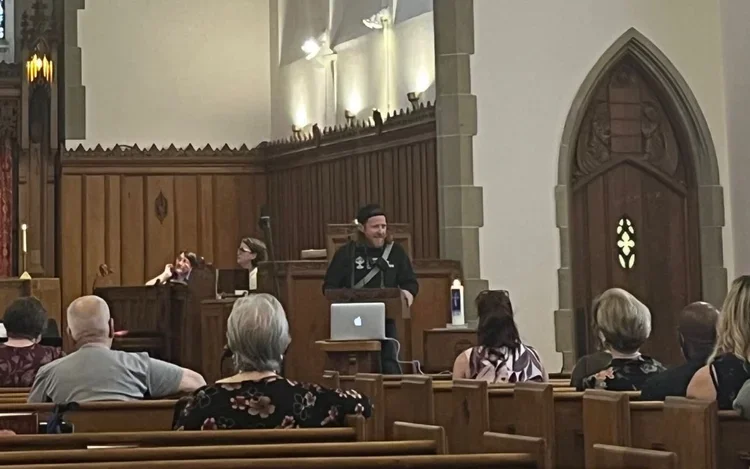
A few years ago, at the invitation of leaders in the Canadian Mental Health Association’s pioneer crisis program and a community-outreach church in northwest Toronto, I stood before a Christian congregation on a Sunday morning in Eastertide and gave an address.
Not as a parish priest. Not as a man in vestments. Not as someone speaking from the safety of theory.
I stood there as a crisis worker, a mental health specialist, a first responder, with a police radio strapped to my chest and a backwards crisis cap on my head.
And I told the truth.
I told them that even my presence in front of them was an expression of privilege. White skin. Male body. Clerical bearing I could still put on when needed. The learned cadence of someone trained to speak in rooms where people listen. I told them that whatever I had lost, there were people in this city losing more every day, with less sympathy and fewer exits. Poor people. Racialized people. The addicted. The mentally ill. The abandoned. The ones polite society prefers to discuss as social problems rather than meet as human beings.
I told them our teams answered 911 and 211 calls all year round. I told them about harm reduction, about a no-wrong-door approach, about trying to meet people in crisis before the police, the ER, the courts, or the grave got the final word. I told them that some of the most compassionate people I had ever worked with were frontline workers standing in the wreckage with almost no glory attached to it.
And I reminded that congregation of something the Church has spent too much time trying to soften: scripture does not reveal a God whose love is handed out like a bland corporate memo. The God of the Bible has always shown a bias toward the poor, the captive, the stranger, the widow, the sick, the sinner, and the disposable.
That is not ideology. That is the text.
The problem is that many churches prefer a God who comforts the comfortable and only occasionally pities the damned. They prefer charity to solidarity. Distance to identification. A manageable Jesus who can be quoted without ever having to be followed into the places where people are actually bleeding out spiritually, mentally, socially, and materially.
But crisis strips away religious bullshit.
In crisis, nobody cares how polished your theology is if you do not show up. Nobody needs another slogan. Nobody is saved by optics.
What people need is presence. Truth. Bread. Shelter. Safety. Treatment. Dignity. Someone willing to say, You are still human, and you are not beyond care.
That morning, I was not speaking as a man above collapse. I was speaking as someone who had known enough ruin to stop romanticizing resurrection. Easter is not for the triumphant. It is for the pierced. For the ashamed. For the ones whose lives have been blown apart and who still have to get up the next morning.
That is what I believe now.
Not cheap hope. Not churchy performance. Not pious branding.
The real thing.
The kind that walks straight into the wreckage and stays there long enough to mean it.