Recently Become Aware
There is a particular kind of lie institutions like to tell when they want to cut someone loose.
It is not usually a dramatic lie. Not the kind shouted across a room. Not the kind that arrives red-faced and wild-eyed. It is a quieter lie than that. A tidier one. A lie on letterhead. A lie written in the language of policy, prudence, and concern. A lie that sounds responsible enough for everyone involved to keep their hands clean.
It goes like this: we have only recently become aware.
On November 3, 2023, I sent a mass email campaign titled Palestine to thousands of subscribers, linking readers to earlier writing of mine from the Dheisheh refugee camp in the West Bank.
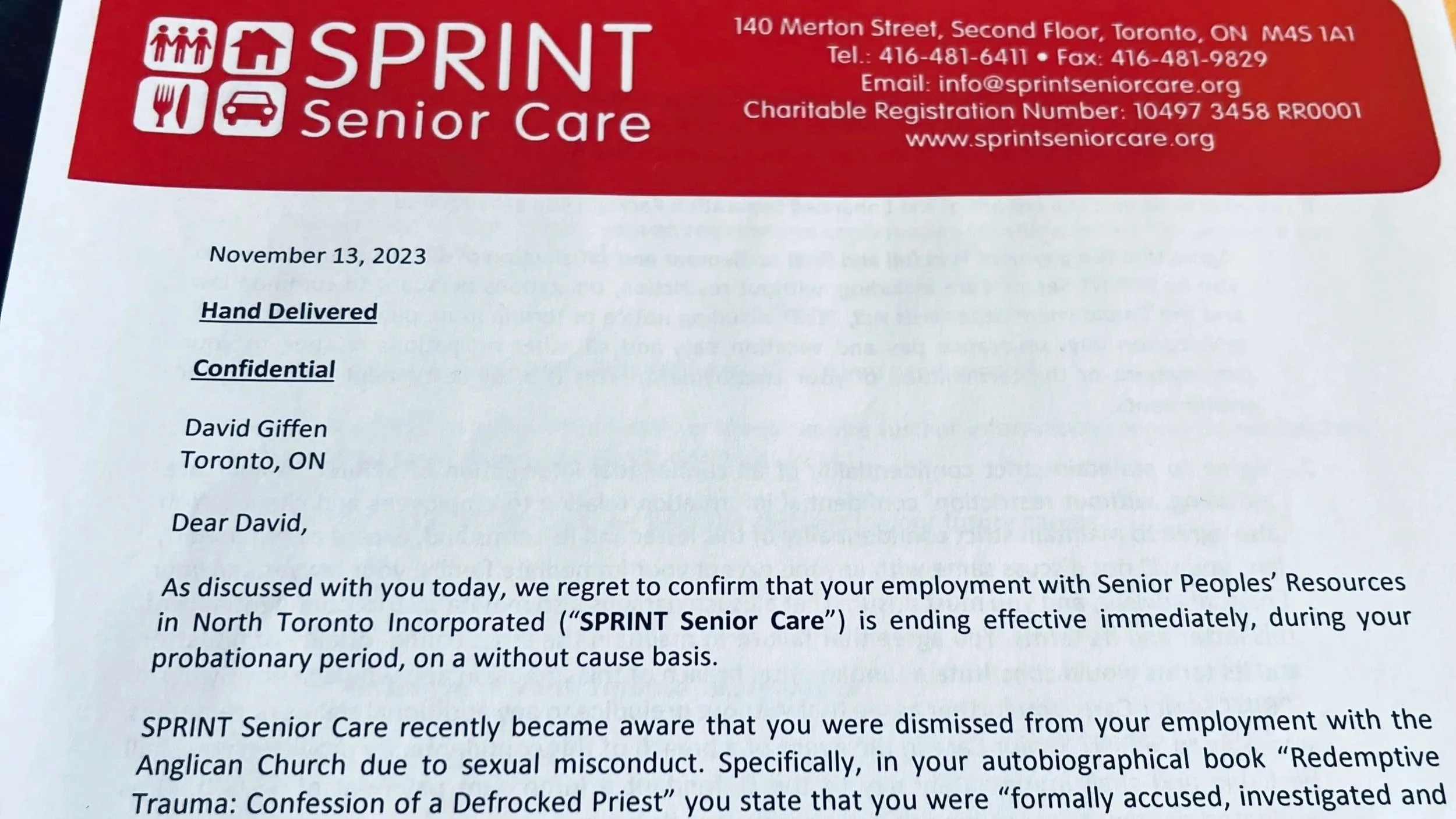
On November 13, 2023, SPRINT Senior Care terminated my employment.
That chronology does not prove motive.
But it does establish timing.
The termination letter said SPRINT had “recently become aware” of my dismissal from the Anglican Church for sexual misconduct. It also said that my own writing in Redemptive Trauma made them no longer comfortable employing me in a role involving vulnerable clients.
Now let me be careful here.
I cannot say, on chronology alone, what was said in private or what finally drove that decision. I cannot prove motive by sequence. Serious people should not claim more than the record can carry.
But serious people are also allowed to notice when a phrase does not sit cleanly with the facts.
Redemptive Trauma was published in 2020. It was on my CV. It was discussed in the interview. My history was not hidden. My disgrace was not hidden. My attempt to tell the truth about my own collapse was not hidden. There were public photographs of me on book tours between Toronto and Cape Breton. One of my references was an Anglican priest. The other was a fellow crisis worker from Toronto’s pioneering Community Crisis Service team — the job I left to accept SPRINT’s offer as Mental Health Team Lead on October 4, 2023.
So yes, I continue to question the phrase recently become aware.
Because institutions do this all the time. They speak as though they have discovered something when what they have really done is decide when something will count. A fact can sit in plain sight for years and remain manageable, usable, forgivable, or conveniently overlooked — until the day it becomes useful to treat it as contamination.
That is the distinction.
I was not a hidden danger being uncovered. I was a known man being reclassified.
And I know something about reclassification.
The church did it. Others have done it. The parts of you they once tolerated, absorbed, overlooked, or even quietly benefited from can later be repackaged as the very reason you must be discarded. The record stays the same. The institutional need changes.
That is how power often works. It does not always invent facts. Sometimes it just changes their meaning.
And the cost is never just administrative.
From the moment I lost that job, I began to unravel. Two weeks later, my fiancée and stepchildren were gone. I never saw them again. Within a month, my son’s mother had begun involving the Children’s Aid Society. The combined blow was devastating. People who have never had a life come apart like that like to imagine that job loss stays in its lane. It does not. Lives do not break in neat categories. Once one wall goes, others often follow.
That is why chronology matters.
Dates. Documents. References. Interview history. Public record. Evidence.
Not fantasy. Not self-pity. Not slogans.
Just the refusal to let the final letter from an institution become the official version of your life.