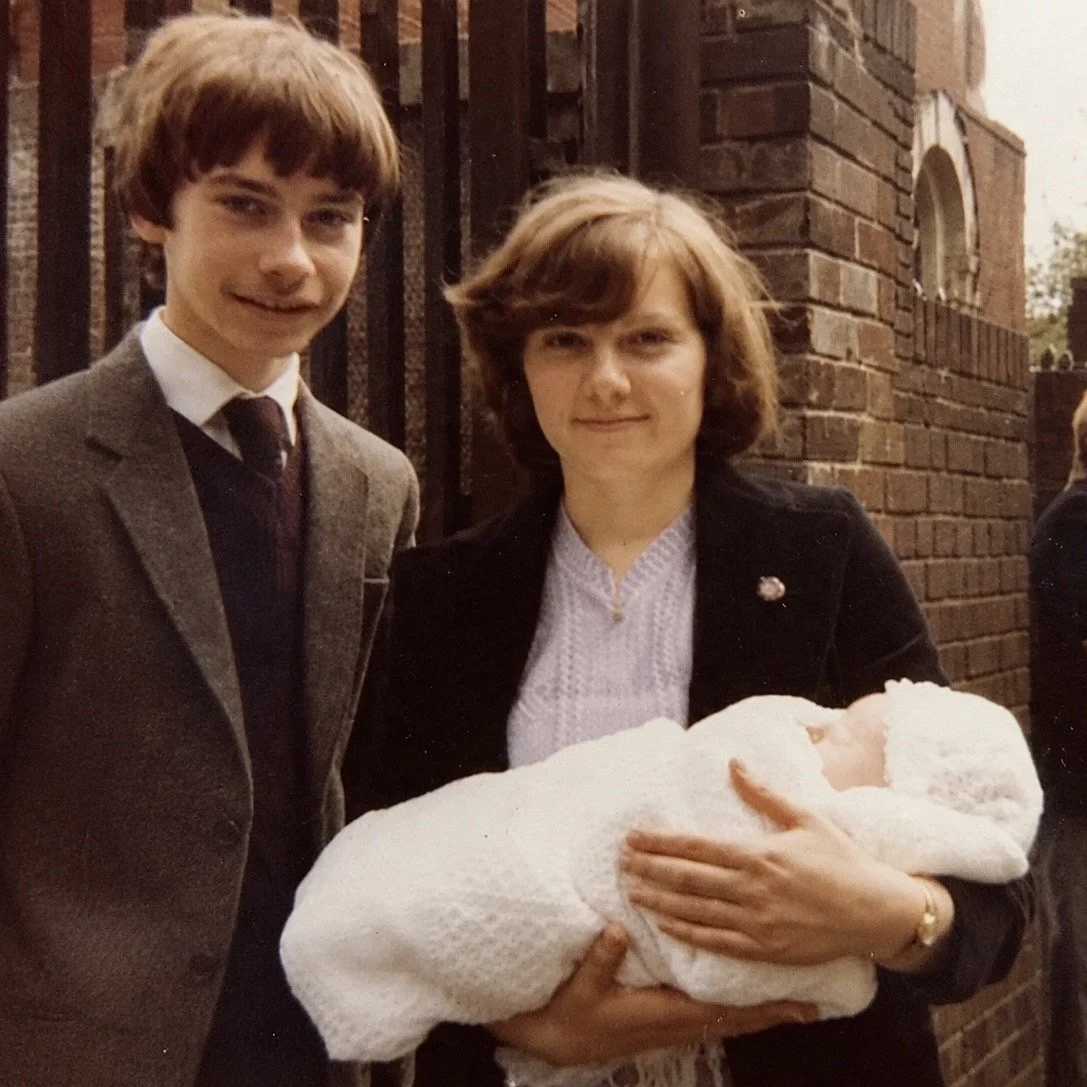
Glasgow Born Catholic
Strictly speaking, nobody is born Catholic.
I was born in Glasgow.
Three weeks later, I was baptized Catholic.
I remember neither.
My birthplace and baptism belong to life before memory. I know them because other people told me and because adults recorded what the child could not keep.
At the font were my young mother, her fourteen-year-old brother, her childhood friend and my Protestant father. Three Catholic teenagers and one Protestant man made promises over a child who could not understand a word of them.
I contributed nothing but my presence.
That is baptism’s first truth. We do not begin by making a case for ourselves. We arrive unable to speak, believe on command or prove our character. Somebody carries us to the water. Grace is spoken before achievement can answer.
Then, before I was old enough to remember Scotland, my family crossed an ocean.
The rite imagined godparents close enough to know the child they had promised to accompany. A year later, an ocean stood between us. There were no video calls, cheap flights or family group chats. Love remained, but relationship thinned. The promises reached Canada mostly as story.
“Godparents” in Redemptive Trauma was my attempt to understand that interruption. I wrote from real pain, but I also wrote some of my family too narrowly, especially my mother. Pain can tell the truth about a wound while making the other people in the room smaller. I know that now.
But the chapter understood one thing I am only beginning to understand fully: nobody baptizes himself.
When my life later collapsed, I did not need adults willing to call wrong right. I needed people capable of holding truth and care in the same hands—people who could help me stand without pretending I had not fallen.
The work of the promise did not disappear when geography disrupted the original arrangement. It changed hands, often without the people carrying it knowing that was what they were doing.
Over the years, people held a corner of the weight without asking for a title. Friends remembered the boy beneath the collar and answered the phone during crisis. A woman on the Via Dolorosa held me while I thought I was helping her. Catholic families refused to leave. Strangers in a Glasgow pub pulled over a chair and gave me a ticket I could not afford.
None of them erased what had happened.
They refused to let it become the only thing happening.
Perhaps that is what the Church was saying before I understood her: no life is self-made. We are given to one another—not to erase consequences, but to make abandonment harder.
I spent much of my adult life trying to turn what I had received into something I could achieve.
Born to a Scottish Protestant father and an Irish Catholic mother, I became an Anglican priest. At twenty-six, the collar seemed to offer a settlement to a conflict older than I was. It gave me language, an office and a place at the altar. It made the Glasgow-born Catholic boy legible inside an institution shaped by another part of his inheritance.
I believed in what I was doing. Grace came through it. People were loved, baptized, married, fed and buried. None of that becomes false because the structure later fell.
But I also asked the Church to lend me a stability I did not possess. I wanted sacrament, usefulness and public trust to accomplish what honesty, treatment, time and relationship had not yet done. The collar did not create that wound, but it gave the wound somewhere impressive to hide.
When the life collapsed, I tried to write it into redemption.
That was the hope behind Redemptive Trauma. If I named the suffering clearly enough, perhaps it would become meaningful and reveal a road back to a redeemed version of me.
It did not.
Trauma is not redemptive. Violence does not become holy because somebody survives it. Telling the story does not release the storyteller from responsibility, and being harmed does not make every account we give of others fair.
The better Christian claim is harder and more modest.
The Cross does not make suffering good.
It makes abandonment impossible.
I think baptism says the same thing.
The water did not prevent me from failing. It did not certify my account or turn Catholic identity into a character reference. Henry VIII knew the Mass. Baptized people have practised racism, sectarianism, colonialism, cruelty and self-protection. Religious identity can become one more costume worn by people determined not to face themselves.
So “Glasgow Born Catholic” is not a declaration of innocence.
Neither birthplace nor baptism can testify for the defence.
Glasgow does not owe me belonging because its name appears on my birth certificate. The Church does not owe me a role because I was baptized into it. Scotland cannot restore an untouched childhood, and Catholicism cannot restore an altar.
I am not coming back as Father.
I am coming back as David.
That distinction matters because Catholic means more than the tribe into which I was baptized. It means universal. My own experience of exclusion cannot become permission to exclude somebody else. The prisoner remains human after guilt. The child remains a child before anyone turns him into a symbol. The person in crisis is more than a problem to be processed. The wrongdoer remains accountable without becoming disposable.
I have been circling that truth in writing for a decade: grace does not remove consequence, and nobody is only the worst true sentence spoken about them. I did not reach that conclusion and then live it consistently. I keep returning to it because I cannot live without it.
Now I worship in Scotland as a layman.
No collar. No place reserved at the altar. No need to pretend Rome is pure or that coming home has solved my life.
When it is time to stand, I stand with everyone else. When it is time to kneel, I kneel. I no longer need the Mass to prove that I am good. I need it to keep telling the truth about what goodness requires.
I was carried to a font before I could remember.
At forty-five, I am still learning how much of life depends upon being carried—and how quickly grace becomes sentiment if I refuse to carry anyone else.
The final prayer ends. The church door opens, and the air off the Firth enters the room.
The people step out into the rain.
I go with them.