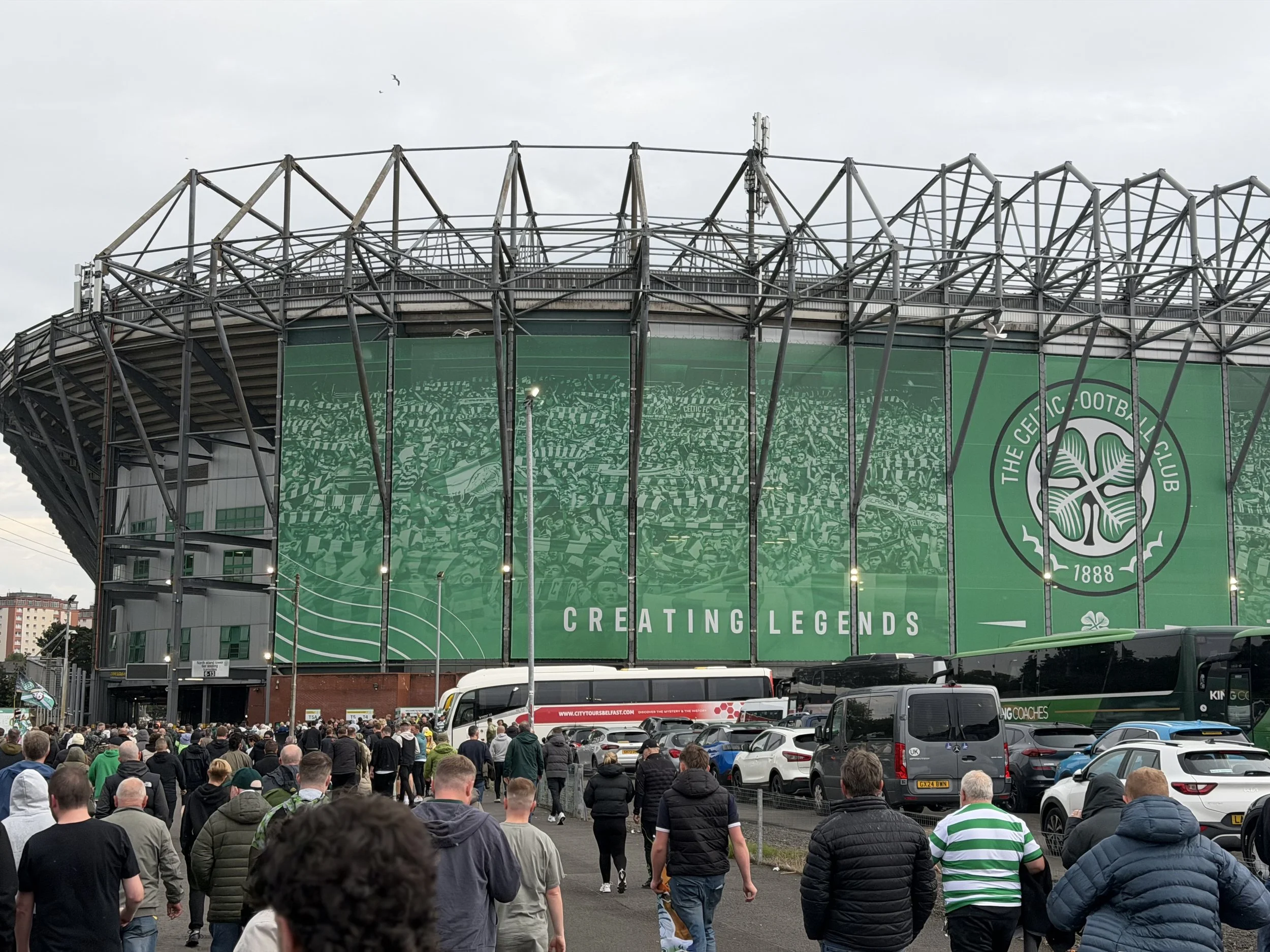
The Walk to Paradise
Somewhere on the walk to Celtic Park, I began thinking about my grandparents.
Eddie and Margaret O’Neil grew up in Catholic Glasgow, not far from Paradise. They later made their home in Bishopbriggs.
Eddie was a charming sales representative who could speak to anyone. He performed in the theatre and became club captain at Kirkintilloch Golf Club.
Margaret taught at St Matthew’s Primary School and later volunteered at the Marie Curie hospice. Her devotion to Eddie showed her children and grandchildren what lifelong Catholic marriage looked like once the wedding was over and the ordinary years began.
Eddie died in 2021.
Margaret followed him seven weeks later.
I was in Canada.
By the time I returned to Scotland, their absence had made the search feel urgent.
Old addresses.
Churches.
Photographs.
The places my family had left behind.
I thought ancestry was something I would find by looking backwards.
Then Glasgow handed me a ticket and told me to start walking.
I had gone into O’Neill’s alone, expecting to watch Celtic play Dundee on a television. I did not have a ticket and could not afford the resale prices.
The men at the next table noticed.
They asked where I was from, why I sounded Canadian and what I was doing there by myself in a Celtic strip.
Then they gave me their spare ticket.
No negotiation.
No inflated price.
No price at all.
When I asked why, one of them looked at me as though the answer should have been obvious.
“Because Celtic takes care of their family.”
Not long afterwards, we were outside, joining the crowd moving east.
The walk to Celtic Park is not a heritage tour.
It is roads, railway arches, pubs, takeaways, traffic and uneven pavements. People emerge from side streets and join the flow. Scarves appear. Songs begin without anyone announcing them. Friends call to one another across the road.
The closer you get to Parkhead, the less anyone needs directions.
The crowd knows the way.
I followed.
This was the Glasgow that had formed Eddie and Margaret.
Not these exact pavements, necessarily. I will not manufacture a family memory because it makes the story neater.
But this was their world.
It was shaped by parish, school, family and Celtic—a world that offered belonging, but also drew hard lines between communities.
I had inherited pieces of it in Canada.
Prayers.
Warnings.
Names.
A sense that Celtic meant more than football, even when nobody stopped to explain exactly why.
I had the pieces.
I did not have the map.
On the road to Paradise, the map began to appear.
My grandparents had never been ancestors to themselves.
They were Eddie and Margaret.
Eddie called on clients, played golf and performed in the theatre.
Margaret taught children, volunteered at the Marie Curie hospice and remained devoted to Eddie throughout their life together.
They raised children, welcomed grandchildren and made a home in Bishopbriggs.
Glasgow was not their heritage.
It was where they caught buses, bought messages, met friends and got on with the day.
I had spent years asking where I came from.
They had simply come from here.
As we walked, Celtic Park began to make itself known.
First through the crowd.
Then through the sound.
Finally, above the buildings, the stadium itself.
From Canada, Paradise had existed on a screen.
Floodlights.
Songs.
A crowd whose roar arrived through television speakers thousands of miles away.
But television had shown me the stadium without showing me the road.
It had shown me the destination without showing me how people reached it together.
That was what I had missed.
Paradise did not begin at the turnstiles.
It began at a table in O’Neill’s when strangers noticed I was alone.
It continued when they pulled over a chair.
When they gave me the ticket.
When they told me I was coming with them.
There was something familiar in that welcome.
Eddie knew how to enter a room, find the conversation and make people feel at ease.
Margaret taught us something quieter.
Love was not merely what you said when the room was full and everyone was listening.
It was what you kept doing after the excitement had passed.
Eddie and Margaret taught us that belonging came with responsibilities.
The men walking beside me simply acted as though that were obvious.
They did not know my grandparents.
They did not know what kind of grandson I had been, how long I had been away or why walking through Glasgow mattered so much.
They knew only what was in front of them.
I was alone.
I had no ticket.
They had one.
That was enough.
Glasgow can be like that.
Solidarity without ceremony.
Affection disguised as instruction.
Kindness delivered so bluntly that you might mistake it for an order.
Move your pint.
Pull over a chair.
You’re sitting with us.
You’re coming to Paradise.
Keep walking.
By then, the stadium had risen fully above the East End.
I had imagined that moment for years.
I thought seeing Celtic Park would be the thing that moved me most.
It was not.
What moved me was who had brought me there.
I entered Paradise with people who had been strangers at the beginning of the evening.
That is why Paradise matters.
Not because a football ground can prove where I belong, or because Celtic can resolve every contradiction in my family, my faith or this city.
It matters because of the road.
Eddie made room for people.
Margaret lived the promises she had made.
Their children and grandchildren learned that love was not simply something you felt.
It was something you did.
For years, I had imagined ancestry as a trail leading backwards.
Eddie.
Margaret.
The people who came before them.
Names, dates and stories disappearing into the past.
But ancestry also travels forward.
Five years after they died, I walked through the city that had formed them with men I had met in a pub, carrying a ticket I had not been able to afford.
Those men could not return my grandparents to me.
But they showed me that the inheritance was still alive.
Pull out the chair.
Give him the ticket.
Do not let him walk alone.
Take care of your family.
Giff on the Way Home.