Wha’s Like Us?
“Wha’s like us? Damn few, and they’re a’ deid.”
I am writing this at Dublin Airport, waiting to fly home after two days with a man I had never really had the chance to know.
Except, somehow, I already knew him.
Rob knew him first.
They lived together at university. Somewhere in those years, friendship crossed that invisible line where friends become brothers.
Rob and I came to each other from an earlier part of his life. Different years. Different stories. Different versions of the same man.
And this week, nearly four years after Rob died, he brought us together.
I don’t know how else to describe it.
I came to Ireland because I wanted to spend time with someone who had loved my brother.
Instead, I found another piece of him.
For two days, I was welcomed into a family home by people who had every reason to regard me as a stranger and somehow never made me feel like one.
Yesterday evening, we gathered around the family table with his wife and kids for a feast. We told stories. We laughed. And somewhere in the middle of it all, I remembered again what it feels like to belong.
We played golf in Wicklow.
We wandered Dublin.
We drank Guinness.
We listened to music in pubs.
We stood above a lake under an enormous Irish sky.
We talked about our lives.
And inevitably, constantly, wonderfully, we talked about Rob.
There were stories I had never heard.
Connections neither of us knew existed.
Moments when one of us would describe something Rob had done, years apart from the other’s experience of him, and the response was immediate.
Of course he fucking did.
Because that was Rob.
We had known different versions of him.
But we had known the same man.
I knew the boy from Markham.
The friend who could tell stories about me from before almost anyone else in my adult life knew my name.
The man Rory knew simply as Uncle Rob.
But there was an entire Rob who existed when I wasn’t in the room.
University Rob.
Years, friendships, mistakes, jokes and stories that belonged to other people.
Those stories were never mine.
Now I get to know some of them too.
When someone dies, we tend to think their story has ended.
Maybe that isn’t quite right.
The person stops adding chapters, but the people who loved them are still carrying pages none of the others have read.
Sometimes we get lucky enough to find one another.
And the story gets bigger again.
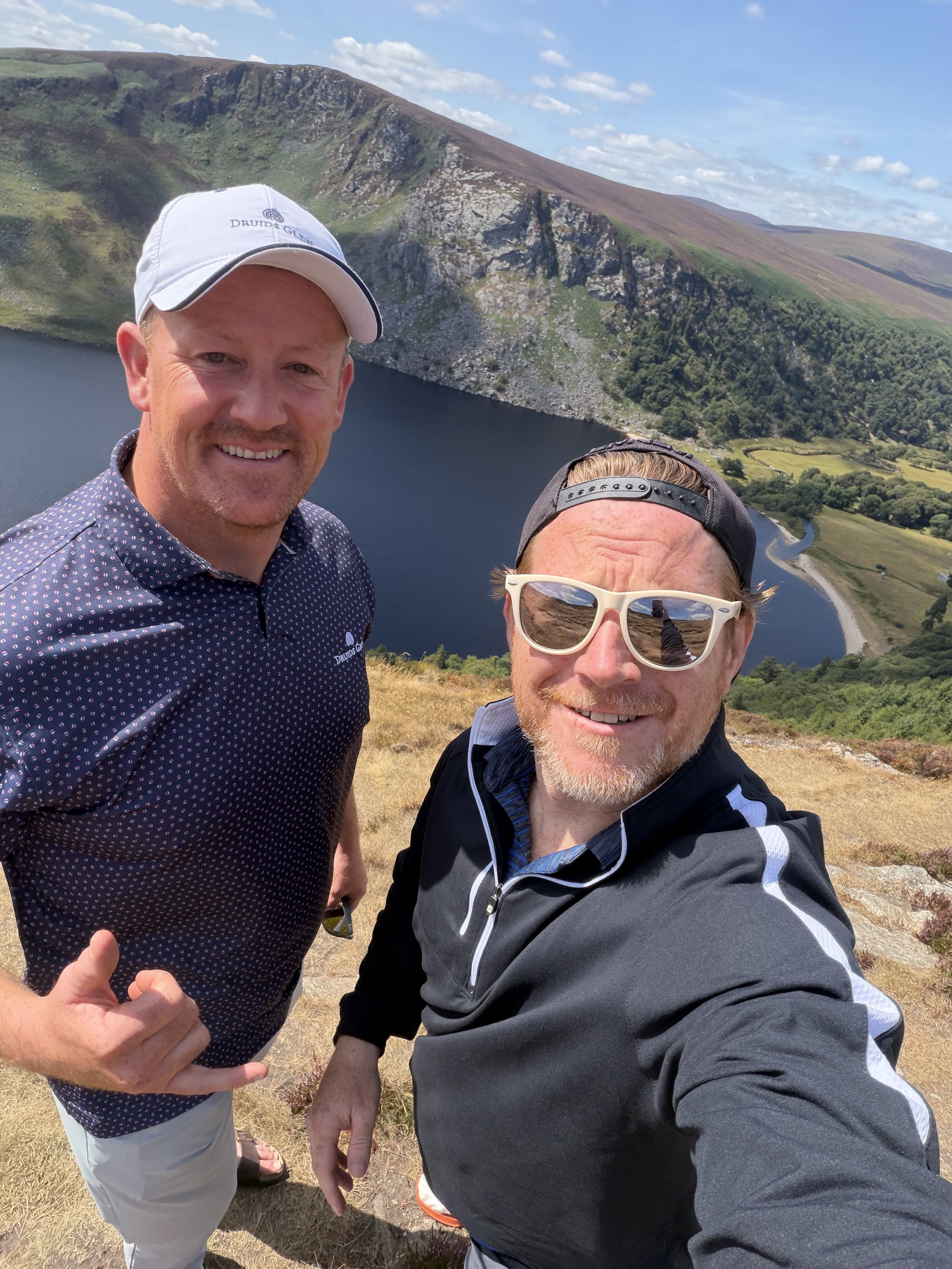
There is a photograph from yesterday of the two of us standing high above a lake in Wicklow.
If you didn’t know the story, you would see two friends on a beautiful day in Ireland.
And in a way, that is exactly what it is.
What the photograph cannot show is the third man standing between us.
The one who got us there.
Rob has been dead for almost four years, and the bastard is still introducing people.
I think he would enjoy that.
Actually, I know he would.
He had a way of becoming family in places where no blood relationship required it.
Brother.
Uncle.
Friend.
The title changed depending on who was speaking.
The relationship underneath it didn’t.
And apparently those relationships still know how to find one another.
There is a Scottish expression I have always loved.
Wha’s like us?
And the answer:
Damn few, and they’re a’ deid.
It is funny in that wonderfully Scottish way where affection, pride and death are somehow allowed to occupy the same sentence.
This weekend, though, it landed differently.
They say we die twice.
Once when we stop breathing and return to God.
And again when the last person who remembers us says our name.
I thought about that a lot in Ireland.
Because every time one of us began a sentence with—
“Do you remember when Rob…”
—something happened.
For a moment, the tense changed.
He wasn’t someone who was.
He was Rob.
Funny.
Infuriating.
Loyal.
Complicated.
Loved.
Not polished into sainthood because he is gone.
Not defined by the fact that he died.
Just Rob.
And every story gave another piece of him back.
That feels increasingly connected to what this journey home has become.
When I arrived in Scotland four weeks ago, I thought coming home would mostly be about geography.
The Ayrshire coast.
Glasgow.
Oban.
The islands.
Celtic Park.
The towns my family came from and the names that remained in our house long after we crossed an ocean.
I have been walking through landscapes trying to understand where I belong.
But increasingly, home has become less about finding the right place and more about finding the threads.
A stranger at Celtic Park gives you a ticket because Celtic takes care of its family.
A name carved into a memorial connects you to someone who lived generations before you.
A family in Ireland opens its home because of someone you both loved.
Except somehow he is still the one making the introduction.
Maybe home is partly that.
The place where the pieces of your life begin recognizing one another.
I left Scotland for Ireland with one backpack.
I am going back with the same one.
Nothing tangible has changed.
But I am carrying more than I arrived with.
More stories.
More of Rob.
A friendship that did not exist two days ago in quite the same way.
And gratitude for a family who made room at their table for someone connected to them by nothing more—and nothing less—than love for the same person.
There is sadness in all of this.
Of course there is.
There were moments when the missing seat was obvious.
But strangely, these two days did not feel primarily like mourning.
They felt like life.
Golf.
Pints.
Music.
Bad jokes.
Long conversations.
Irish roads.
A ridiculous amount of laughter.
The ordinary things people do when they are together.
Perhaps that was the best memorial we could have given him.
We didn’t spend two days standing beside his absence.
We lived.
And we brought him with us.
So somewhere between Dublin and home, I find myself thinking about that old line again.
Wha’s like us?
Damn few.
And some of the best of us are deid.
But not entirely.
Not while somebody remembers the story.
Not while Rory knows the name Uncle Rob.
Not while two people from completely different chapters of a man’s life discover they have been carrying pieces of the same person all these years.
Not while someone begins another sentence:
“Do you remember when Rob…”
Not while I am here to say his name.
Rob Crocco.
My brother.
Yesterday, two men who loved him stood above a lake in Ireland, told stories, laughed and became friends.
Rob brought us together.
We kept him alive another day.
Today, I’ll say his name again.