There Is Something Merciless About an Old Photograph
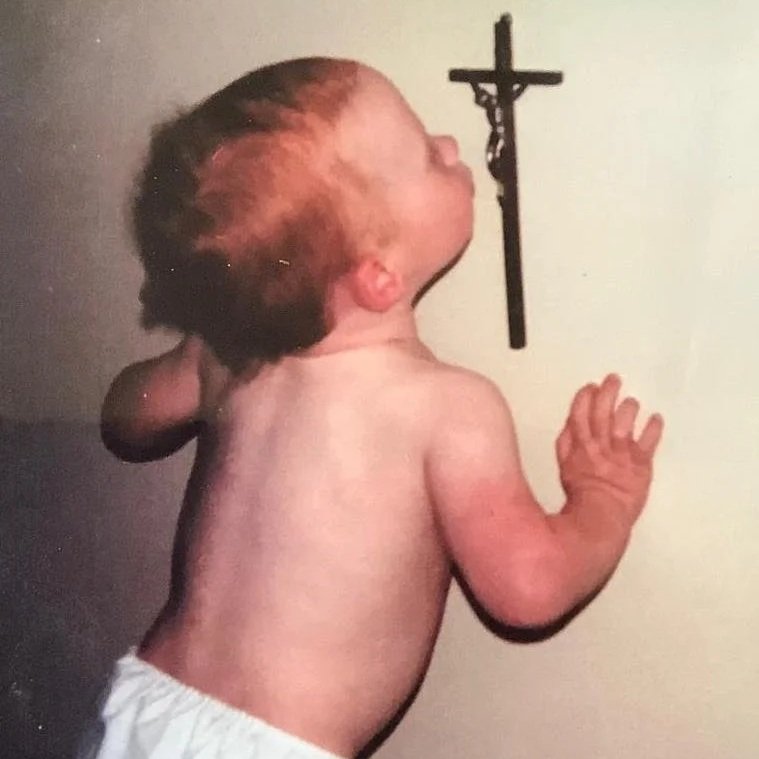
Reaching before understanding.
Holy Tuesday and the mercy hidden inside hard truth.
There is something merciless about an old photograph.
Not because it lies, but because it tells the truth before you have the strength to understand it.
This is me as a little boy, reaching toward a crucifix on the wall. Bare-backed. Unsteady. Curious. Drawn toward the broken body of Christ before I had words for doctrine, betrayal, power, or pain. Before I knew what institutions would protect—and what they would not. Before I knew what families could normalize. Before I knew how often religion can speak the language of love while hiding from the truth.
I was just reaching.
And that feels right for Tuesday in Holy Week.
Palm Sunday is over. The branches are already drying out. The public enthusiasm has begun to rot. By Tuesday, the mood has shifted. The machinery is already moving in the dark. Betrayal is no longer hypothetical. Judas has stopped being a warning and become a man in motion. The system is closing ranks. The people with authority are preparing to preserve order at someone else’s expense.
That is what makes Holy Tuesday so unsettling.
It is the day religion begins to show its hand.
Not at its best. At its most familiar.
This is the day when appearances still hold, but rot has already set in underneath. The prayers continue. The customs remain. The language sounds holy enough. But somewhere behind the scenes, truth is being priced out, negotiated away, and handed over with professional calm. Tuesday is not yet the violence of Friday. It is the consent that makes Friday possible.
Maybe that is why this photograph reaches me now in a way it could not have years ago.
Because the child in it does not know any of that yet.
He does not know what betrayal will cost. He does not know how often fear dresses itself up as wisdom. He does not know how quickly institutions will sacrifice a person to save a reputation. He does not know that some of the people who speak most fluently about grace are still terrified of truth.
He only knows he is drawn to the crucified.
That matters to me.
Because the Cross is not decoration. It is not branding. It is not religious nostalgia for people who want faith without risk. The Cross is where God goes when the world has done its worst. It is where innocence is crushed by power, where truth is abandoned by cowards, where love refuses to disappear even when everything around it has become calculation, self-protection, and violence.
And somehow, before I knew any of that, I was reaching for it.
Not because I understood it. Because something in me already knew that whatever was hanging there was closer to the truth than most of what passed for order around me.
That little boy did not know what the Cross would cost him. He did not know how much of life would be spent trying to survive betrayal without becoming its disciple. He did not know how often truth would come without applause. He did not know how tempting it would be to choose image over honesty, silence over exposure, bitterness over mercy.
But he reached anyway.
Maybe that is faith in its most honest form.
Not certainty. Not performance. Not mastery.
Just hunger. Just longing. Just the instinct that the broken Christ on the wall is not there to shame us, but to meet us in the place where the world breaks us and call that place holy ground.
This is Tuesday in Holy Week.
Before the table breaks. Before the garden fills with footsteps. Before silver does what silver does.
And I look at that child and think: before I knew what the Cross would cost, I was already reaching toward it.
Despite everything, I still am.