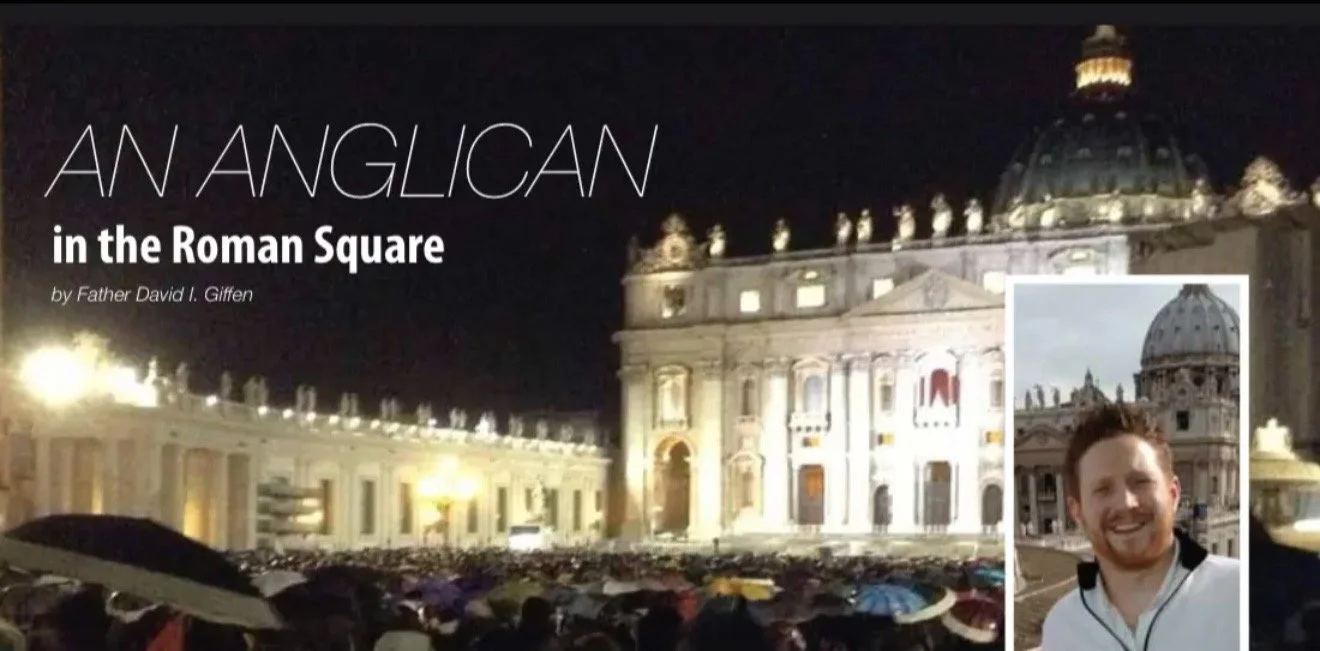
When the Square Felt Like Pentecost
In 2013, I stood in St. Peter’s Square as an Anglican and believed, for a moment, that humility might still be strong enough to interrupt power.
It was raining. We waited for hours. The crowd swelled with astonishing speed, from thousands to hundreds of thousands, as though the whole city were being pulled toward one balcony, one voice, one name. Languages pressed in from every side. Italian, English, Spanish, French, German, and others I could not place. It should have felt like confusion. Instead, it felt like recognition.
It felt, for a moment, like Pentecost.
Not because we were all the same.
Because somehow the moment became intelligible before it was even explained.
Then Francis stepped out and said, “Buona sera.”
That was the first rupture.
Not Latin.
Not distance.
Not the full performance of sacred grandeur.
Just a human greeting.
And then the second: before blessing the crowd, he asked the crowd to bless him.
I remember how that landed. In one of the most choreographed institutions on earth, humility seemed to step briefly in front of power. Not abolish it. Not redeem it. But interrupt it. The square held its breath, and the world did too.
At the time, I wrote about that night as “An Anglican in the Roman Square.” I wrote as someone moved by grace, struck by unity, surprised by how deeply I felt addressed in a place not my own. I meant it. I do not mock that younger man. He saw something real.
But he did not yet understand how institutions work.
He did not yet understand how quickly humility can be aestheticized. How easily a gesture can be baptized as transformation. How readily vast systems absorb the language of gentleness while leaving their underlying arrangements intact. He had not yet lived enough to know that a holy moment and a holy institution are not the same thing.
That is the harder truth.
A crowd can recognize something true.
A balcony can frame it beautifully.
A leader can embody it sincerely.
And still the machine beneath it all may remain what it was.
That is not cynicism. It is discipleship after disillusionment.
I still believe something happened in that square. I still believe the simplicity of that greeting mattered. I still believe there was something profoundly Christian in a man asking the people to pray for him before presuming to lead them.
But I no longer confuse a moment of humility with a structure of repentance.
The Church’s crisis has never been that it lacks beauty, language, ritual, or memory. It has all of those in abundance. Its crisis is that it too often mistakes them for conversion. It knows how to stage reverence. It does not always know how to submit to judgment.
So yes, I remember that rainy night in Rome with gratitude.
But not innocence.
What I saw was real.
What I hoped was larger than what followed.
And what the Church still requires is more than a humble tone on a balcony.
It requires the kind of repentance that no crowd can perform for it.