A Room for Scotland
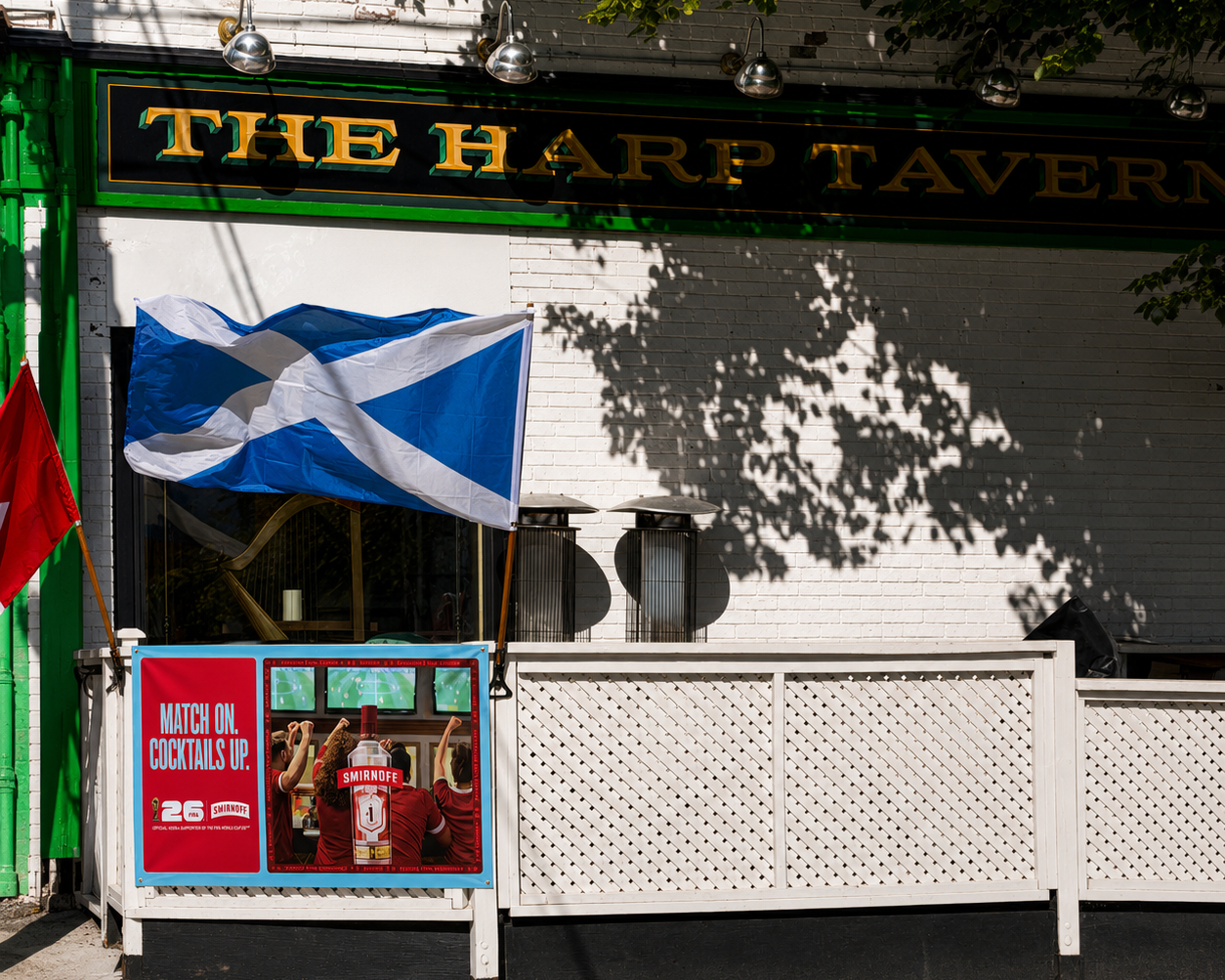
Just after the Harp Tavern reopened in April, and after knowing the Quinn family for almost no time at all, I had the audacity to lobby the bartender.
Could their Irish pub in Toronto become a Scotland pub for the World Cup?
It was a slightly ridiculous request.
Irish pubs tend to know exactly what they are. Scots also know exactly how much of a room we can take up once football is involved.
The Quinns said yes.
They did not take down the Irish flag or pretend the Harp had suddenly become a Glasgow local.
They put the Saltire outside on one of the busiest streets in the city and invited Scotland through the door.
The Harp never stopped being an Irish pub.
That was the point.
The Quinns understood that it was never really about filling the place with Scots. With Toronto’s changing demographics, getting Scots through the door was sometimes the hardest part.
Instead, the Irish came.
Canadians came.
Colombians, Brazilians and Spaniards came.
People arrived wearing the colours of whichever country they loved, inherited or had chosen for the day.
Nobody had to explain why a team, a flag or a country thousands of miles away still mattered to them.
At the time, I thought I had found somewhere to watch football.
I did not understand what the Harp would come to mean.
As the World Cup moved towards its final matches, I took a six-and-a-half-hour flight across the Atlantic and came back to Glasgow.
I cheered for Argentina against England alongside a room full of Scots, with the ghost of Maradona never far away.
I sang Flower of Scotland among my own people.
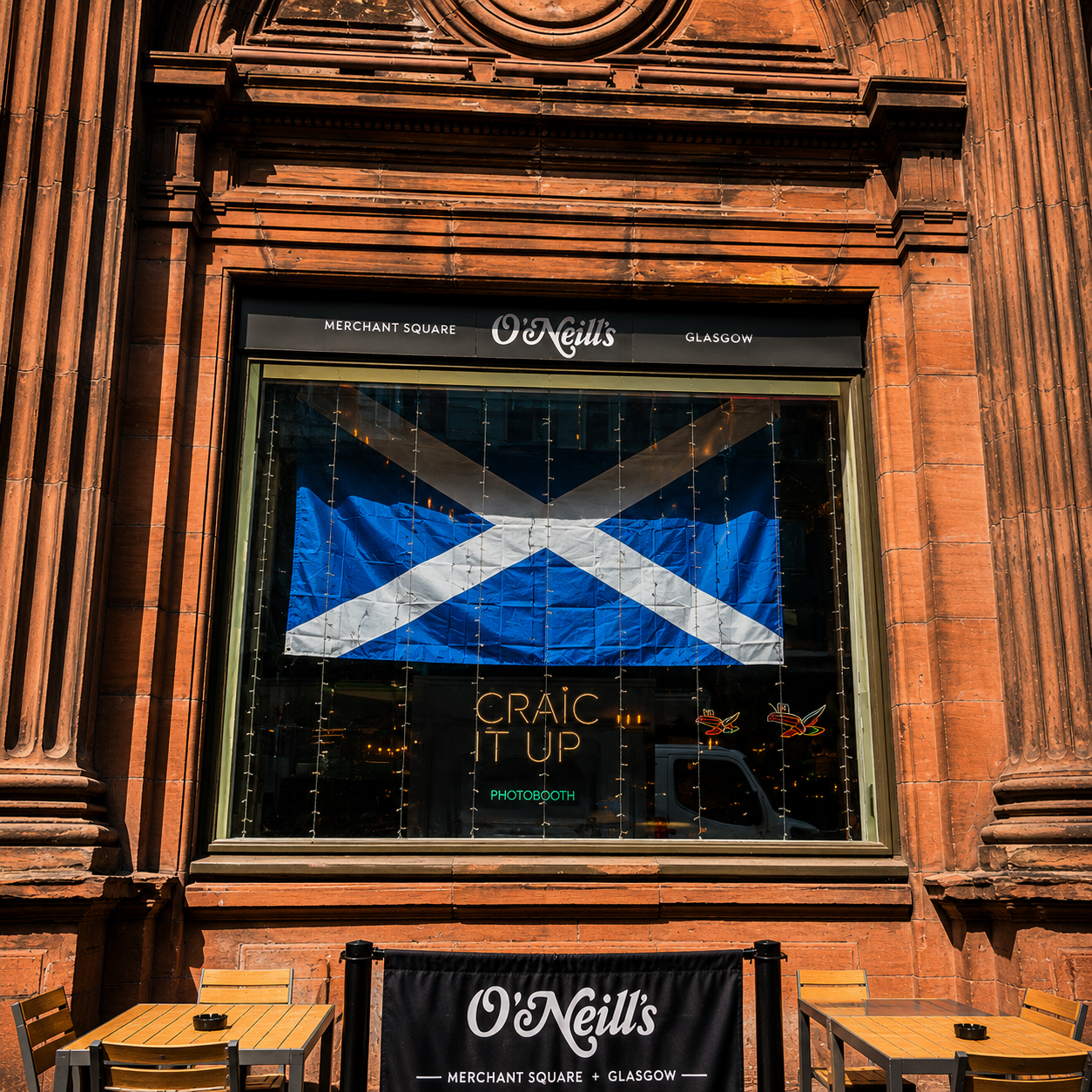
Then, walking through the Merchant City, I stopped outside O’Neill’s.
An Irish pub.
The Saltire filled the windows.
Underneath it were three words:
CRAIC IT UP.
I stood there grinning.
The Quinn family had raised the Saltire at an Irish pub in Toronto.
An Irish pub in Glasgow had done the same.
It felt familiar.
I was born in Glasgow to a Scottish Protestant father and an Irish Catholic mother, then raised in Canada carrying both.
A Giffen and an O’Neil.
Scotland and Ireland were never abstract places in our family. They lived in surnames, accents, churches, football, stories and arguments that crossed the Atlantic with us.
Like many Scottish and Irish families, ours was complicated.
There is enough history between Scotland and Ireland to fill several libraries and ruin several dinners.
But standing outside O’Neill’s, I was not thinking about the history.
I was thinking about the Quinns—and the generations of Irish families who built places like the Harp and O’Neill’s far from home.
They had not asked me to become less Scottish before welcoming me into their Irish pub.
They helped me raise the flag.
That is what stayed with me.
My first weeks back in Scotland have been full of ruins, memorials and names cut into stone.
I have spent a lot of time looking at what Scotland lost.
Outside O’Neill’s, I was reminded to notice something living.
A flag went up.
A door opened.
I came home asking whether Scotland would make room for me.
Months earlier, an Irish family in Toronto already had.
The Harp did not become less Irish.
It gave Scotland a room.
We’re cousins.
Slàinte.
Giff on the Way Home.