Before Memory
I do not remember Scotland.
That is the first truth, and it has always unsettled me—that my life began somewhere I cannot return to except through other people’s voices.
My origin exists as testimony, not memory.
Photographs. Stories told over kitchen tables. Fragments delivered cautiously, sometimes defensively, sometimes with affection, but never with complete certainty.
I know that I was born in Glasgow.
I know there were grandparents who held me, rooms in which I slept, and voices I must once have recognised. I know there was a world around me before I became capable of keeping any part of it.
But I cannot see it.
On 26 July 1982, I left Scotland for Canada.
I was fourteen months old.
I do not remember the airport. I do not remember the flight. I do not remember anyone saying goodbye or Scotland disappearing beneath the clouds.
Before I could form a stable memory, I was taken across an ocean.
Immigration stories are usually told as triumphs.
Fresh start. Opportunity. Courage.
Adults narrate them this way because the alternative—admitting fear, instability and loss—can feel too much like failure.
A family leaves one country because it believes another might offer something better. Work. Security. Possibility. A future larger than the one being left behind.
But children experience immigration differently.
For them, it is not reinvention.
It is dislocation without explanation.
My first clear memory is Canada.
Arrival week.
The air felt different. Sharper. Larger somehow. Houses unfamiliar in proportion and sound. Voices louder and faster. Everyone moving with an urgency I could not understand.
I remember cousins first.
Older children fascinated by the new arrival from Scotland.
They were not cruel. They were simply unaware of fragility. Children can cause harm long before they understand it.
I had been held differently before—grandparents’ hands steady and careful, movements slowed by reverence for small life.
Here, the energy was faster.
Louder.
Playful, but overwhelming.
I was chased through rooms still strange to me.
A door slammed.
My foot was underneath it.
Pain arrived instantly—total and disorienting.
Blood spreading across my foot.
Adults rushing in.
Panic replacing laughter.
Voices rising, apologies forming too late to matter.
It was my first clear memory.
Not faces.
Not words.
Impact.
The body remembers impact long after explanation fades.
Later, the story would be retold gently, almost humorously.
A childhood accident. Nothing unusual.
Remember when David first arrived and cut his foot?
No one had intended to hurt me. Children had been playing. A door closed at the wrong moment.
All of that was true.
But memory preserved something the family story did not.
The sudden discovery that safety could disappear without warning, even among people who loved you.
Even in celebration.
Even at the beginning of a new life.
Immigrant families survive through momentum.
There is little time to stop and understand what has been lost. Work must be found. Bills must be paid. New streets must be learned.
Adults focus forward.
Children absorb what remains unspoken.
My parents were young. Younger than I understood for most of my life.
They were trying to establish themselves in a country that was unfamiliar to them too. Canada was not simply the place where they brought their child. It was the place where all of us had to learn new rooms, new voices and new rules.
Canada became the country of nearly every memory I possess.
It is where I learned to speak, went to school, made friends, found faith and became a father.
Canada was never merely the place where I arrived.
It became home because it was where life happened.
Scotland remained beneath it.
A birthplace.
A name on a certificate.
An answer followed by an explanation.
I was born in Glasgow, but—
There was always a but.
But we left when I was a baby.
But I grew up in Canada.
But I do not remember it.
For forty-four years, the story moved in one direction.
Scotland was the country before memory.
Canada was where memory began.
During the pandemic years, I lost both of my grandparents. Two cousins died by suicide during the lockdown years.
By the time I returned, the family that carried those early stories had become smaller.
Some stories could still be told.
Others had gone with the people who carried them.
Family history is often spoken of as though it were permanent, waiting somewhere to be recovered.
It is not.
It lives inside people.
Today, 26 July 2026, marks forty-four years since I left Scotland.
For the first time, I am spending that anniversary here.
Coming back does not restore what I cannot remember. The Scotland I left no longer exists, and the child who left it cannot be recovered.
There is no untouched version of my life waiting here.
No alternative childhood preserved in the landscape.
The people are older.
Some are gone.
The stories have changed through repetition, grief and time.
Coming back does not reverse the journey.
It changes the place from which I tell it.
The country that existed for most of my life as inheritance and imagination is now beneath my feet.
And still, my first clear memory belongs to Canada.
A strange house.
Children running.
A closing door.
Blood.
The foot healed.
I learned the unfamiliar rooms. I learned the voices. I learned how to belong to the life that followed.
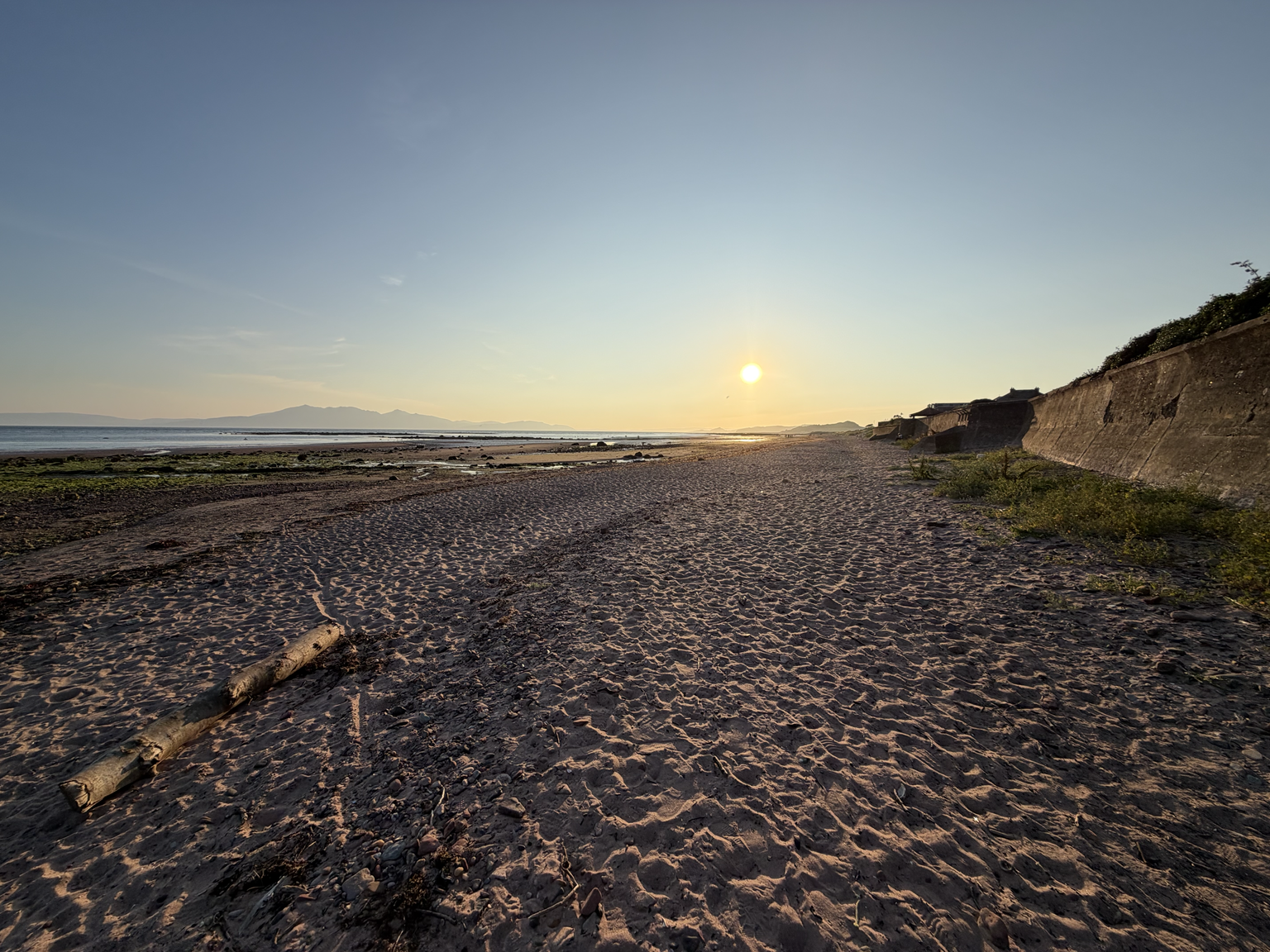
Later today, I may walk down toward the water and look west.
Somewhere beyond the horizon is the country where memory began.
Behind me is the country that came before it.
I cannot remember leaving Scotland.
But today, forty-four years later, I am standing inside the part of my life that came before memory.
Giff on the Way Home.