Be Careful What You Bury
St Mungo, Glasgow Cathedral and the people who refuse to stay dead
The first resurrection in Glasgow’s story was a bird.
According to the legend, a group of boys killed St Serf’s robin and placed the body beside the young Kentigern, hoping he would be blamed.
Kentigern took the bird into his hands.
He prayed.
The bird lived.
Kentigern would become Mungo—the “dear one”—Glasgow’s patron saint. The robin that was killed and made into evidence against him still appears on the city’s coat of arms.
The creature they tried to use against him became part of the city’s identity.
That feels like more than a charming story about a medieval saint.
It feels like a warning.
Mungo was born to a woman the powerful had already decided was disposable.
His mother, Thenew—later remembered as St Enoch—was cast out by her father after becoming pregnant through sexual violence. According to the tradition, she survived an attempt to kill her, crossed the Firth of Forth in a boat without oars and reached Culross, where her son was born.
She survived violence, exile and abandonment.
Her child became the patron saint of Glasgow.
Before Glasgow had a cathedral, it had a discarded woman.
Before it had a bishop, it had her surviving child.
Before it had a civic crest, it had a dead bird somebody else had tried to blame on him.
The city begins with people who were supposed to disappear.
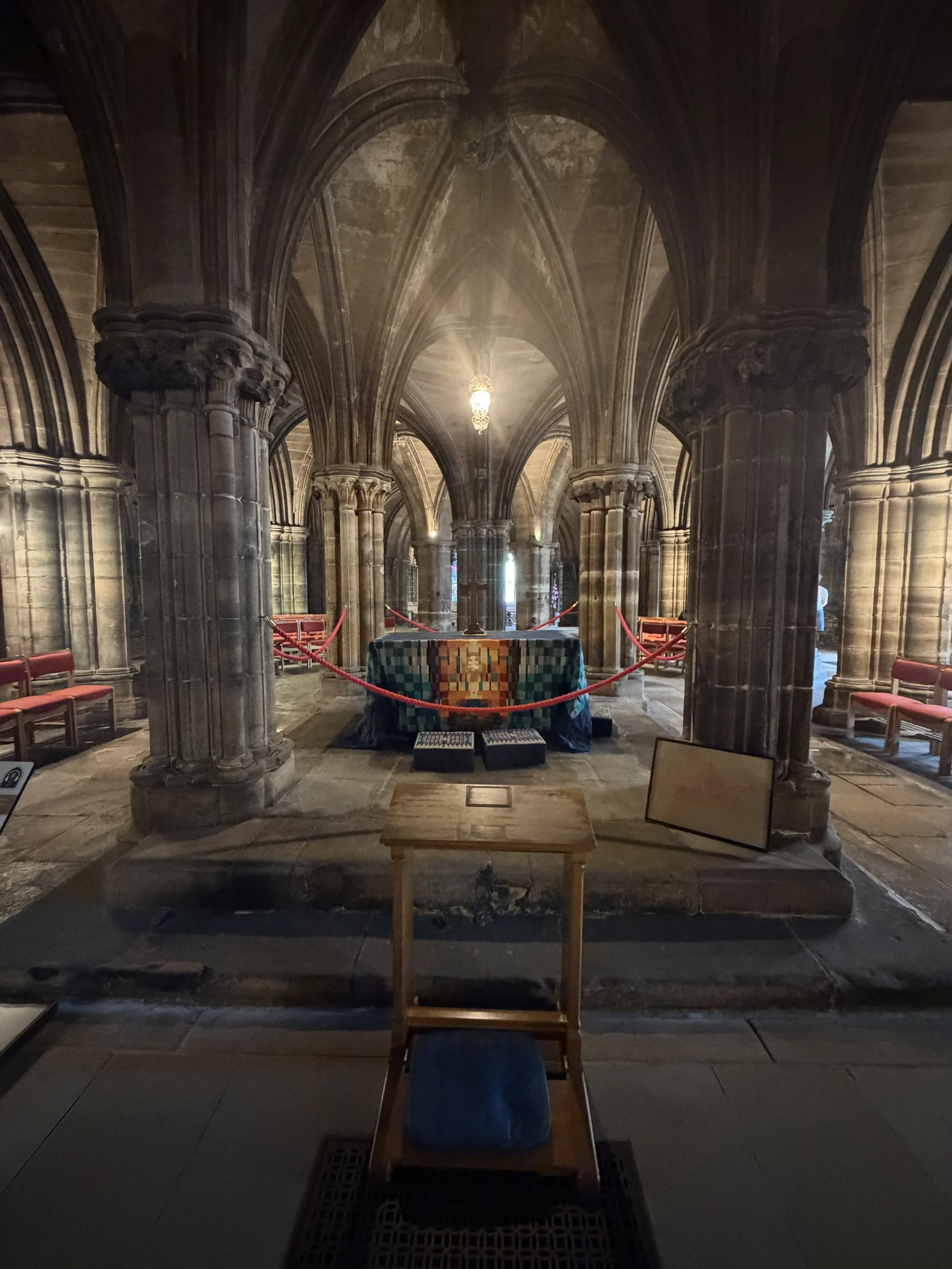
Mungo established a religious community beside the Molendinar Burn. After his death, he was buried near the place where Glasgow Cathedral now stands. His shrine became a destination for medieval pilgrims, and the great Lower Church was built around his tomb.
Glasgow did not simply build over its founding grave.
It built around it.
I stood there this week.
I was born in Glasgow in 1981 and taken to Canada the following year. In the years between leaving and returning, I became a priest and then ceased to be one. I broke apart publicly. I worked on the front lines of mental-health crisis. I entered recovery. I began trying to understand what remained after the titles, institutions and explanations had fallen away.
There are easier places for me to stand than at the tomb of a bishop.
But there I was.
No collar.
No office.
No institution left to impress.
Just a man standing beneath an ancient cathedral, looking at the grave of another man whose influence outlived every institution that claimed the right to define him.
I know something about institutional burial.
A title is removed.
A decision is issued.
A file is closed.
The language becomes final.
Former.
Removed.
Disgraced.
Unwell.
Finished.
The institution speaks in the past tense and expects the person inside that language to remain there.
Quietly.
That does not make me innocent.
Some of what happened to me was unjust. Some of it was self-inflicted. Much of it was more complicated than either my defenders or my critics wanted it to be.
Resurrection is not acquittal.
It does not erase responsibility. It does not repair every relationship, restore every office or return anyone to the life they had before.
Nor should it.
Some lives cannot be rebuilt in their former shape.
Some versions of us need to remain dead.
But accountability is not annihilation.
No institution, court, church, employer or public audience earns permanent ownership of another human being’s ending.
The resurrected do not come back unchanged.
They return knowing what the grave feels like.
They remember who stayed.
They remember who walked away.
And they remember who buried them.
Glasgow Cathedral survived the Reformation virtually intact, but not unchanged. Its Catholic furnishings were stripped away. The medieval cathedral became a parish kirk—at one point, three separate kirks operating within the same stone building.
The structure endured.
The institution changed.
Mungo remained beneath it.
We use the word survival too easily.
Survival can mean learning to function inside damage.
It can mean becoming useful enough that nobody has to ask what happened.
It can mean carrying the language placed upon you so convincingly that eventually you mistake it for your name.
Resurrection is more disruptive.
It is the return of the person everyone had already agreed to discuss in the past tense.
It is the voice that remains after the title has been removed.
It is the life that continues after the institution has published its final version.
It is not becoming respectable again.
Sometimes it is simply still being here.
Still speaking.
Still refusing to allow the people who buried you to become the sole authors of what happened.
I did not come home to Scotland to recover the man I was before.
That man is gone.
Parts of him deserved to go.
Homecoming is not the reconstruction of a dead life. It is the discovery of what survived it.
Standing at Mungo’s tomb, I understood that Glasgow’s founding stories are not really about triumph.
They are about what power fails to destroy.
The violated woman survives the exile.
The accused child becomes the saint.
The murdered bird rises in his hands.
The buried man becomes the centre around which a cathedral—and eventually a city—is built.
The bird they killed is still on Glasgow’s crest.
The man they buried is still beneath its cathedral.
And some of us are still here.
Be careful what you bury.
Giff on the Way Home.