What Portencross Keeps
Robert II, the Spanish Armada and the histories above and beneath the Clyde
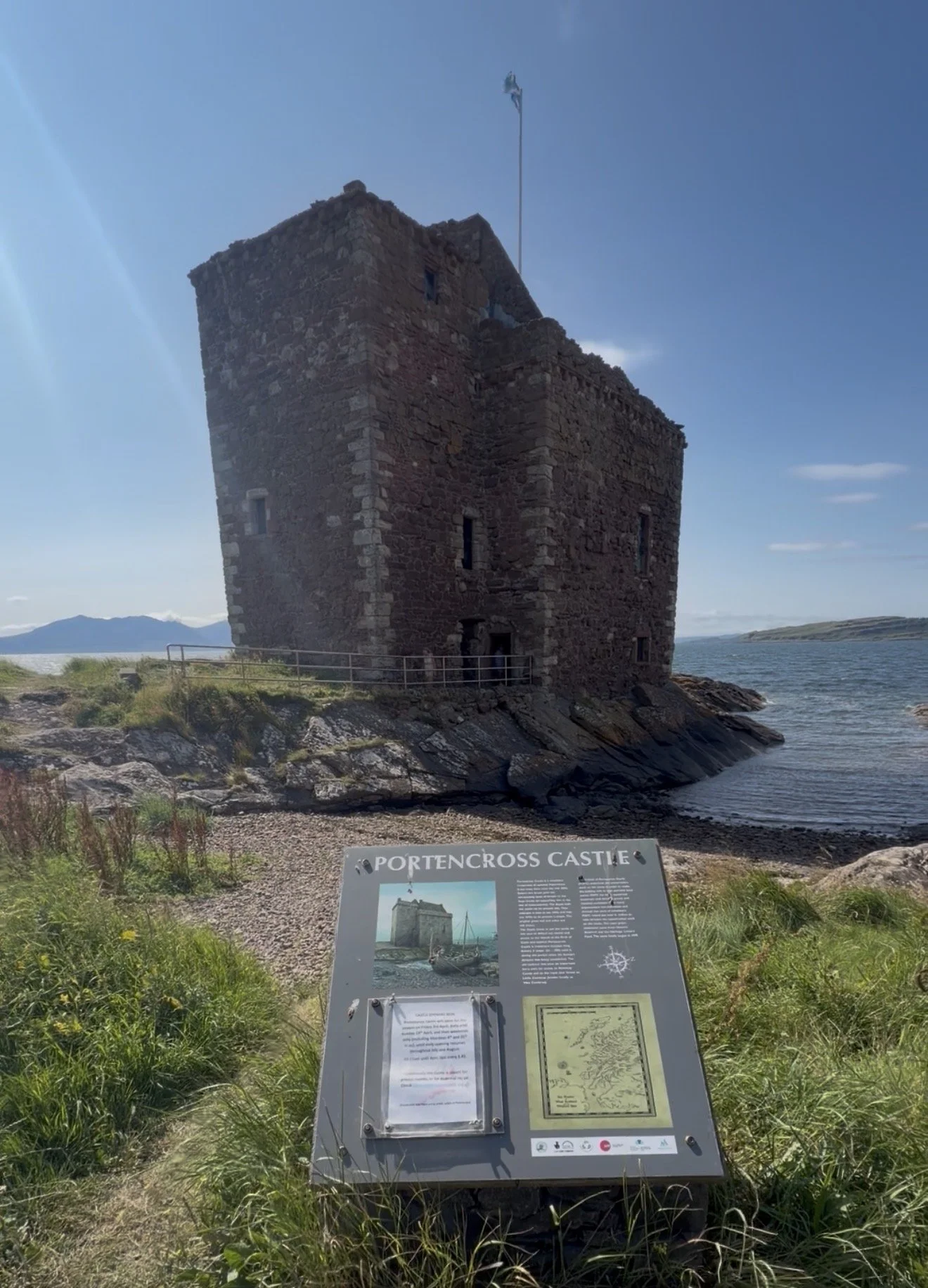
Portencross Castle is smaller than the history gathered around it.
It stands on bare rock beside a narrow harbour, close enough to the water that the sea feels like part of the building. In many ways, it is. The castle exists where it does because the Clyde was once a road rather than a boundary.
Modern maps teach us to see coastlines as endings. Land stops. Water begins. Portencross appears remote because it sits near the edge.
Medieval Scotland understood the place differently.
From this harbour, boats could cross toward Arran, Bute and the western islands. Portencross connected the Stewart stronghold at Dundonald with Rothesay Castle and the wider territories beyond it. It did not stand at the end of Scotland, but at one of its western doorways.
The present castle dates from around 1360. Its importance grew after Robert Stewart became Robert II in 1371, the first of Scotland’s Stewart kings. Fifteen royal acts or charters issued during his reign were dated at Arnele, the old name for the surrounding estate, and were probably signed inside Portencross Castle.
This was not one ceremonial visit later enlarged by local legend. Royal business was conducted here repeatedly.
Standing inside the vaulted hall, it is not difficult to imagine the work of government taking place: clerks preparing parchment, witnesses gathering, and decisions about land, inheritance and authority being turned into ink, wax and law.
The Stewart dynasty would rule Scotland for more than three hundred years. It would produce James IV, Mary Queen of Scots and James VI, who inherited the English crown in 1603.
But dynasties do not begin as dynasties.
Robert II did not know everything the Stewart name would become. He was simply the king standing in the room.
That is one of the things Portencross does well. It brings history back down to human size.
Then there is the wreck offshore.
About a quarter of a mile from the castle lies the reported site of a large wooden vessel long associated with the Spanish Armada of 1588. After its failed attempt to invade England, the Armada was scattered, and surviving ships were forced to return to Spain by sailing north around Scotland and down the Atlantic coast.
Some never made it home.
In 1740, divers were directed to the wreck by local people. Ten bronze and ten iron cannon were reportedly raised from the water, and one was later presented to the village. The site has never been formally excavated, however, and the identity of the ship has not been conclusively established.
That uncertainty does not weaken the story.
There was a substantial wreck beneath the water. There were cannon. Local people knew where it was long before men arrived with equipment to recover what they could.
The truth is already enough.
Above the water, the name of a king survives because it was written into royal documents. Beneath it, the names of the sailors have disappeared.
Robert II remains in the archive. The men aboard the wreck survive only in fragments: iron, timber, sand and a story carried along the coast.
That difference is not about whose life mattered more. It is about what power preserves. History remembers the hand that signed the charter more readily than the hands that pulled the ropes.
From the roof of the castle, Arran fills the western horizon. Holy Island rises farther south, and the Ayrshire coast stretches away in both directions. The landscape becomes a map, but not a static one. These waters carried kings, merchants, fishermen, soldiers and strangers trying to reach another shore.
I have spent most of my life thinking of Scotland as the place my family left and to which I might one day return. That makes home sound fixed, as though Scotland remained here unchanged while I lived somewhere else.
Portencross corrects that idea.
Scotland did not stand still. It was crossed, contested, inherited, cleared, abandoned and rebuilt. Its people left. Others arrived. Kings travelled through small harbours. Foreign ships broke apart beneath its waters. Castles lost their roofs and were later recovered by communities unwilling to let them disappear.
Portencross itself was unroofed by a storm in 1739. For generations it stood exposed before local people organized to preserve it and return it to public use.
Survival did not mean remaining untouched. It meant that enough remained to be recovered.
I came back across the Atlantic carrying a Scottish name, a Canadian life and the hope that one might finally explain the other.
Portencross offers no clean explanation.
It offers stone above the water, iron beneath it, a king whose name survived and a ship whose name did not.
And a castle still standing between them.
Home may not be the place where nothing was lost.
It may be the place where what remains is finally enough to tell the truth.