Glasgow’s Mandela
Standing With the Accused Before History Made It Safe
At the top of Buchanan Street, Glasgow gives an address to a man once meant to disappear.
Nelson Mandela Place wraps around St George’s Tron. People cross it carrying shopping bags. Most often do not stop to think about the name above them.
But the name was once a provocation.
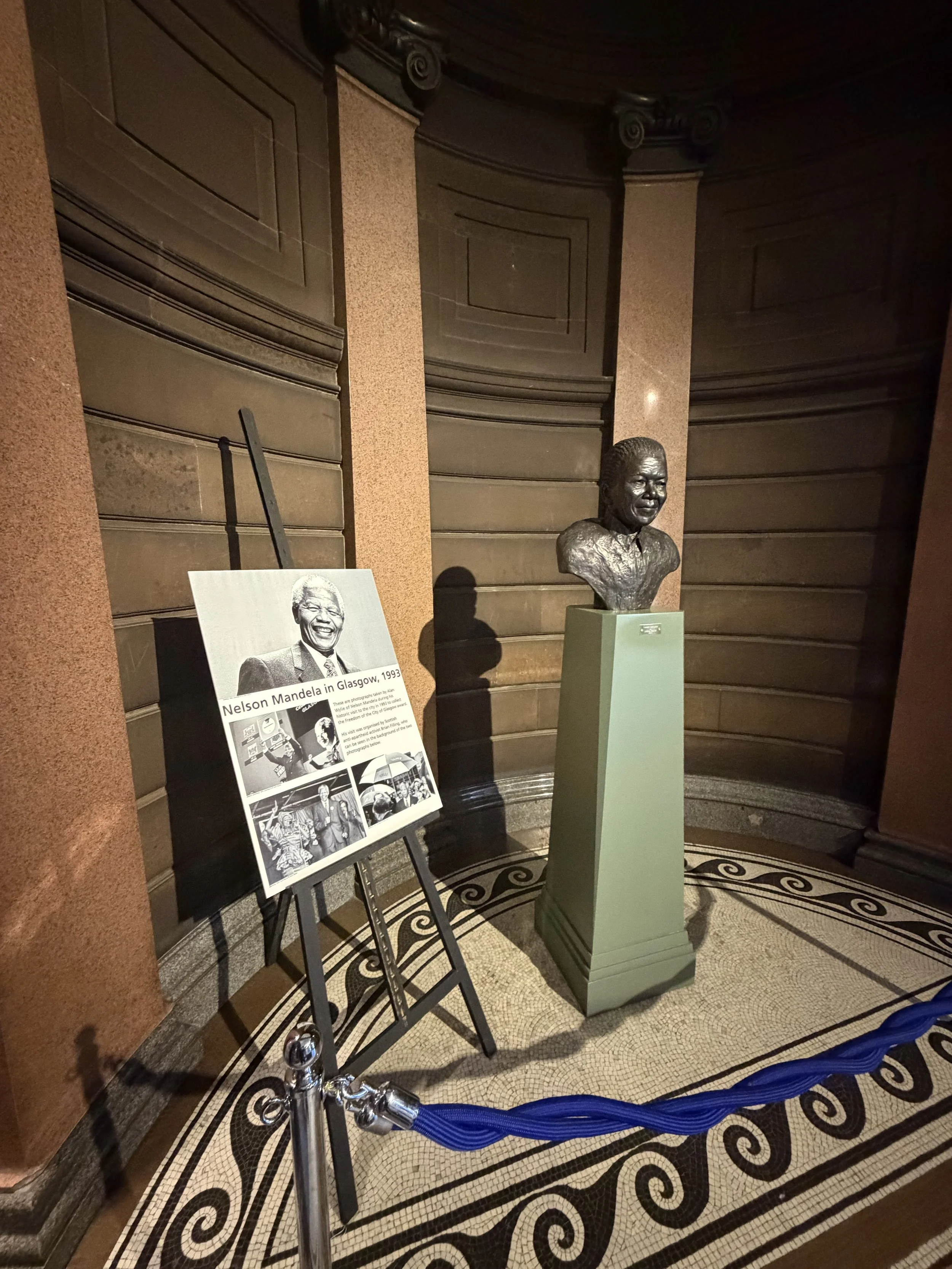
On 4 August 1981, Glasgow granted Nelson Mandela the Freedom of the City. He was not there to receive it. He was serving a life sentence in South Africa, having been convicted of sabotage in the Rivonia Trial.
Glasgow became the first city in the world to honour him in this way while he remained behind bars.
That is the part worth remembering.
The city did not wait for Mandela to be released, elected president, awarded the Nobel Peace Prize and turned into a safe symbol of reconciliation.
It stood with him while he was still a prisoner.
While the South African government still called him a criminal.
While that word was supposed to end the conversation.
Mandela was not passive, harmless or politically convenient. He had helped establish Umkhonto we Sizwe, the armed wing of the African National Congress. He defended sabotage against the infrastructure of apartheid after peaceful resistance had been met with bans, arrests and state violence.
He had broken the law.
The law was apartheid.
Both things were true.
That does not make Mandela morally guilty in the ordinary sense. His conviction came from a racist state defending an unjust system. But Glasgow still had to decide whether the existence of charges, evidence, a trial and a sentence would be allowed to contain the whole meaning of his life.
It decided they would not.
In 1986, Glasgow made the point impossible to miss. The city renamed St George’s Place as Nelson Mandela Place. The South African consulate had offices there, which meant the representatives of apartheid were forced to conduct their business from an address carrying the name of the prisoner their government wanted forgotten.
It was only a street sign.
It was also Glasgow telling power that it did not own the final word.
A conviction tells us what a court has decided. It does not always tell us everything we need to know about the law, the institution or the person standing before it.
That is where Mandela’s story opens into a harder question.
What do we do not only with the wrongly accused or unjustly convicted, but with the guilty?
I said recently on a podcast that I stand with the criminal, the homeless, the accused and the guilty because when Jesus proclaimed freedom for prisoners, he was not talking only about the innocent ones.
I stand by it.
Mercy offered only to the innocent is not mercy.
It is approval.
Christian compassion becomes easy when it is reserved for people who have been cleared, vindicated or proven respectable. There is little cost in standing beside someone once history has repaired their reputation.
The harder test comes before that.
It comes with the person who has failed.
The person whose guilt is real.
The person who has caused harm, broken trust, served a sentence, lost a title or become too complicated for respectable people to defend.
Standing with that person does not mean calling guilt innocence.
It does not mean dismissing harm, opposing consequences or asking victims to remain close to those who hurt them. Safety matters. Boundaries matter. Accountability matters.
But abandonment is not justice.
People say they believe in rehabilitation. Then they refuse to be seen with anyone who needs it.
They say nobody should be defined by their worst mistake. Then they speak about the accused as though the accusation is a complete biography.
The accused becomes the accusation.
The guilty becomes the guilt.
The person disappears inside the noun.
Standing with the accused means refusing that disappearance.
Standing with the guilty means believing that punishment has limits, that rehabilitation is more than a slogan and that human worth survives human failure.
It means telling the truth about wrongdoing without pretending the wrongdoer has stopped being human.
That is not weakness.
It is the difference between accountability and annihilation.
When Mandela finally came to Glasgow on 9 October 1993, thousands gathered in George Square. Apartheid was collapsing. The prisoner was becoming a president. Much of the world was already rewriting its memory to place itself on the right side of his story.
Mandela remembered who had stood with him before it was safe.
Glasgow’s courage belonged to that earlier moment.
It belonged to 1981, when he was still behind bars.
It belonged to 1986, when the city placed his name outside the consulate of the government that held him there.
History is generous to the vindicated.
Faith asks more of us.
It asks whether we can stand beside people while the story is still ugly, while accusation still carries consequences and while guilt remains guilt.
Not because guilt does not matter.
Because guilt is not God.
Glasgow did not wait for Mandela to become respectable before recognizing his humanity.
The street still carries his name.
Giff on the Way Home.