Looking for a Signal
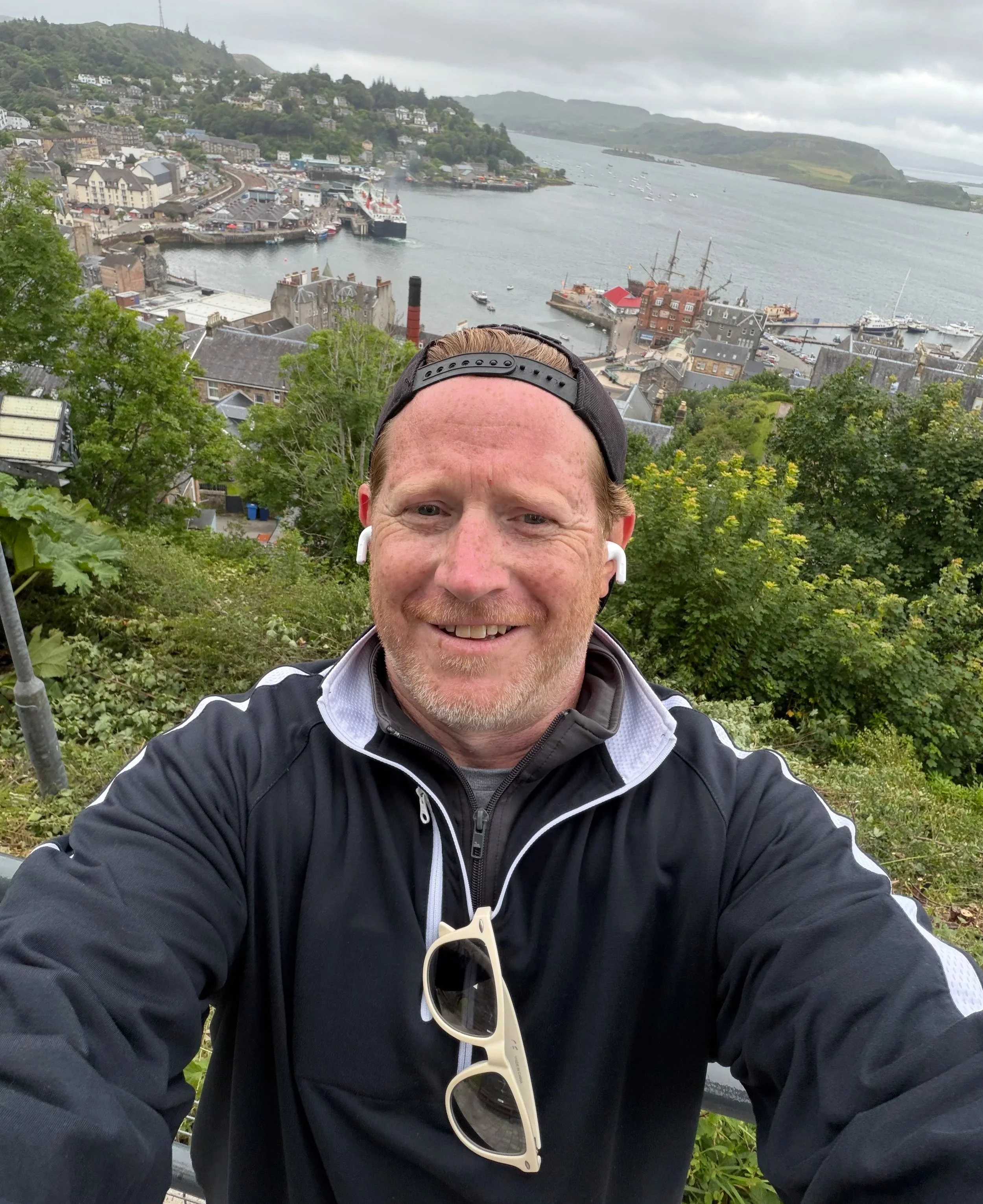
By the time I reached the top of McCaig’s Tower, I was looking for a signal.
Oban had opened beneath me: slate roofs, the bay, ferries moving between the mainland and the islands beyond. It was the kind of view people travel across the world to stand in front of.
I was holding my phone above my head.
One bar.
Gone.
Back again.
This is apparently how I appreciate Scotland now.
I film the walk up. Stop to get the shot without the bins in it. Wait for someone in a bright jacket to move out of frame. Film the reveal. Film it again because I turned too quickly the first time. Try to record something useful while the wind makes every piece of audio sound as though it was captured from inside a helicopter.
By the time I reach the top, I am already thinking about the edit.
What is the opening shot?
Which music belongs here?
What is the first line?
Who should I tag?
Will the local page accept the collaboration?
Then I start walking around with my phone in the air, trying to find enough reception to send Scotland out into the world.
The strange thing is that it is working.
The reels are travelling farther than I expected. Thousands of people are watching. Some are sharing them. Local businesses and organisations are joining the collaborations. Brodick Golf Club accepted one from Arran, placing its name beside a reel made by a man who had arrived on the ferry, walked across the island and tried to show what he found.
I am proud of that.
That may be important to say plainly.
There is a habit among writers and artists of pretending the audience does not matter. We say we would make the work even if nobody watched, read or listened.
Maybe.
But it feels good when they do.
It feels good when someone says they had never heard of Portencross Castle and now want to visit. It feels good when people who know a place recognise it in the work, while people elsewhere discover it for the first time.
I have become surprisingly good at turning a ruined castle into sixty seconds of internet.
The phone in my hand is no longer just a camera. It is my office, notebook, editing suite, map and publishing house. It tells me which train I am about to miss, where the path continues and whether anyone has watched the reel I stayed awake editing the night before.
It is also becoming part of how I might remain here.
I did not return to Scotland with a secure job, a permanent address or a carefully constructed five-year plan. I came with a passport, temporary accommodation, an idea of home and enough experience of plans collapsing not to pretend I had everything worked out.
I knew I wanted to write.
I knew I wanted to film.
I knew there were stories here I wanted to understand.
I did not know whether any of that could become a life.
There is a difference between making content while travelling and building work in the place where you are trying to stay.
A visitor can take the view and leave.
Someone trying to remain has to ask what they are giving back.
That does not mean every reel needs to become a public-service announcement or a doctoral thesis on responsible tourism. Sometimes a castle can simply be a castle, and a ferry can cross the water without carrying the entire weight of the British Empire.
This is progress for me.
But the work becomes better when the place answers back.
When someone corrects what I have misunderstood.
When a business sees itself in the story.
When people who live there decide the place I have shown is one they recognise.
Coming home has not made me an authority.
It has made me curious.
I notice things because they are still new to me: the names, the distances, the way a road turns and suddenly opens onto water. Someone who has passed the same monument every morning for thirty years may no longer stop to look at it.
Then they tell me what I have missed, which is usually quite a lot.
I have no interest in becoming the Canadian who returns to Scotland and immediately begins explaining Scotland to the Scottish.
That would be an impressive level of colonial efficiency, even for me.
So I am learning to listen as much as I film.
At the top of McCaig’s Tower, the signal finally held long enough for me to check the footage.
The first shot was crooked.
The wind had destroyed anything I might have said to camera.
A man appeared directly in the middle of what I thought had been a clean view of the bay and remained there for almost the entire clip.
Still, there was something usable.
The town below.
The ferries leaving.
The mountains fading into the Atlantic sky.
For years, I imagined coming home as an act of recognition. I would see Scotland, Scotland would somehow recognise me, and the rest would begin to make sense.
Some of that has happened.
But belonging is not the same as remaining.
Remaining requires work. An address. Income. Relationships. Contribution. People who know your name because of what you are doing now, not only because of where you were born or what happened before.
The reel began uploading as I walked towards the steps.
It stalled at twelve per cent.
I lifted the phone once more, turned slowly towards the bay and waited for the signal to return.
Then I put it in my pocket and started back down towards Oban.
Giff on the Way Home.