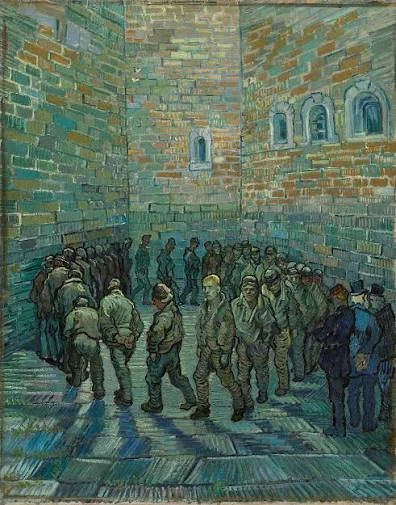
Free the Prisoners. All of Them.
Earlier this year, I wrote Not Soft on Crime.
Then I wrote Not Soft on Cops.
I meant both.
Trauma does not excuse brutality when the wounded person wears a badge.
Guilt does not justify degradation when the wounded person wears jail clothes.
Context does not erase responsibility.
Responsibility does not erase humanity.
Not Soft on Crime ended where this argument begins.
I have walked the psychiatric wings of mental-health hospitals as a clinician, a crisis responder, a priest and a patient.
I have seen the inside of urban jails and holding cells in capacities both personal and professional.
I have known white-collar criminals who would not repent because they could not admit that the rules applied to them. I have known young men—still boys, really—facing decades in prison for crimes their mothers could not accept they had committed.
I have known armed men in uniform who exercised the power of the state with vengeance, arrogance and cruelty. I have known other police officers whose injuries and trauma disorders made their continued willingness to wear the badge an act of extraordinary courage.
I have cared for all of God’s people, regardless of guilt, crime or repentance.
That includes the people they harmed.
I believe in consequences. I believe in the state’s duty to protect people from violence. I believe those who cause harm must be confronted, restrained when necessary and held accountable.
The safety of victims must come first. Their suffering must be believed. Their lives cannot become collateral damage in somebody else’s rehabilitation.
Mercy that ignores victims is sentimentality.
Punishment that abandons offenders is vengeance.
We should should be capable of rejecting both.
I do not make this argument from a safe distance, or from any claim to personal innocence. I have needed accountability, boundaries, treatment and grace myself.
I also know the difference between accountability and annihilation.
Free the prisoners.
All of them.
By freedom, I do not mean the absence of every boundary.
I mean the abolition of imprisonment as punishment.
The only confinement we should tolerate is the least restrictive custody genuinely necessary to protect others, provide treatment and make rehabilitation possible. Every restriction should exist for safety, healing and restoration—not humiliation, retaliation or suffering for its own sake.
Some people need treatment. Some need circles of accountability and support. Some require careful supervision. Others may require secure therapeutic environments for as long as they present a serious danger to those around them.
I do not pretend to know what the safest alternative looks like in every difficult case.
But our failure of imagination does not make deliberate human degradation morally necessary.
If a secure environment becomes a warehouse in which suffering is the product, it is a prison regardless of what we call it.
In April, I made the easier argument: most of the people filling Ontario’s provincial jails had not been convicted. They were awaiting trial and remained legally innocent.
The numbers are stark. As of October 2025, Ontario’s provincial correctional institutions were operating at an average of approximately 130 per cent of capacity, with roughly four out of every five prisoners awaiting trial.
Their legal innocence makes those conditions scandalous.
Their guilt would not make those conditions just.
This is the harder argument.
Even when guilt has been established, human dignity has not been extinguished.
Even the person who committed the crime is still a person.
Even the dangerous person bears the image of God.
Even the unrepentant.
Repentance may be necessary for reconciliation. It may be necessary before trust can be rebuilt or relationships restored. Genuine remorse should matter when determining whether someone can safely return to a community.
But repentance cannot be the price of human dignity.
We do not get to inflict suffering until people become sorry.
We do not get to discard people because the apology has not arrived.
We do not get to make suffering the sacrament of accountability.
Enough with politicians demanding ever-harsher bail laws while most of the people filling our jails have never been convicted.
Enough with being “tough on crime” in the dumbest possible way.
Do not warehouse people and call it public safety.
Do not manufacture suffering and call it accountability.
Do not abandon human beings and call it justice.
Build treatment facilities.
Build rehabilitation centres.
Build dignified environments in which dangerous people can be confronted without being discarded and those they have harmed can remain protected.
Treat mental illness.
Heal trauma.
Break addiction.
Confront violence.
Exorcise hatred and domination.
Call it treatment. Call it rehabilitation. Call it conversion or liberation.
But do the work.
And keep doing it.
This is not simply about being Catholic—although it ought to be a Catholic position.
Catholicism does not deny guilt. It does not excuse harm. It recognizes the state’s duty to protect the common good.
But no human being can be reduced to the worst thing they have ever done. No person ceases to bear the image of God because we are frightened by them, disgusted by them or furious about what they have done.
The Church can argue about the boundaries of punishment.
It cannot worship punishment.
There is no Christian defence of suffering merely for suffering’s sake.
The Christian story places an innocent man, giving himself freely, on the cross for the guilty. It does not authorize the state to place guilty people on crosses of our construction and declare their suffering redemptive.
The cross does not give Christians permission to crucify other people.
A Church cannot proclaim that grace reaches the guilty and then construct its politics upon the premise that the guilty are beyond redemption.
I ended Not Soft on Crime by saying that when Jesus spoke of setting prisoners free, he was not speaking only about the innocent ones.
That was not a flourish.
It was the argument.
I meant it then.
I mean it now.
Free the prisoners.
All of them.
GiffontheWay Home.