You Don’t Get to Be Racist and Irish
Andy Burnham, the Roman Catholic Relief Act, and the bargain of belonging
On 20 July 2026, Andy Burnham became Prime Minister—the first holder of that office to profess the Roman Catholic faith.
He can choose ministers, direct the government and advise the King on the great affairs of state.
But he cannot advise the King on the appointment of a Church of England bishop.
Not because of custom.
Because of law.
Section 18 of the Roman Catholic Relief Act 1829 makes it unlawful for anyone “professing the Roman Catholic religion” to advise the monarch, directly or indirectly, about appointments in the established churches of England and Scotland. The offence is a “high misdemeanour.” The person convicted is to be barred permanently from holding civil or military office under the Crown.
The Prime Minister can advise the King about the country, but not about an Anglican bishop.
The law is nearly two hundred years old. It is still in force.
Its name is almost as revealing as its substance: the Roman Catholic Relief Act.
Relief.
Not equality.
The Act is usually remembered as Catholic Emancipation, and it was a major advance. It allowed Roman Catholics to sit in Parliament and to hold most public offices. Parliament passed it amid fears that British rule in Ireland might otherwise break down—not because suspicion of Catholics had ended. Catholics were admitted into the public life of the United Kingdom, but the Protestant state left a line around its own altar.
You may enter. You may serve. You may even govern.
But there are still rooms in which your presence cannot be trusted.
The constitutional absurdity is especially clear now. The Church supplies a single name for a diocesan appointment; the Prime Minister’s role is largely formal. Burnham can delegate that formality to a minister who is not Catholic. A Jewish Prime Minister would face a parallel statutory restriction. A Muslim, Hindu, atheist or non-practising Anglican Prime Minister is not excluded by Section 18 in the same way.
This is not about Catholics demanding the right to choose Anglican bishops. No Prime Minister should be selecting a church’s bishops. If the appointment belongs to the Church, let the Church make it. If the Prime Minister’s part is merely formal, it should not depend on the Prime Minister’s religion.
Do not keep a nineteenth-century insult alive and call the workaround inclusion.
I notice this law because I was born inside the fault line it preserves.
My mother was nineteen, Irish Catholic and an organist at Mass. My father came from the Protestant world around Falkirk, where Rangers, religion and inherited suspicion could become difficult to separate. I was baptized Catholic near Glasgow in 1981. We inherit stories before we inherit opinions. I had been handed both.
The Irish Catholic side of my family knew what conditional belonging felt like. Irish immigrants in Glasgow and Toronto were poor, foreign and suspect. Their faith was shelter, identity and, often, a line drawn around them by somebody else. History eventually absorbed the Irish into whiteness, but memory moves more slowly than acceptance.
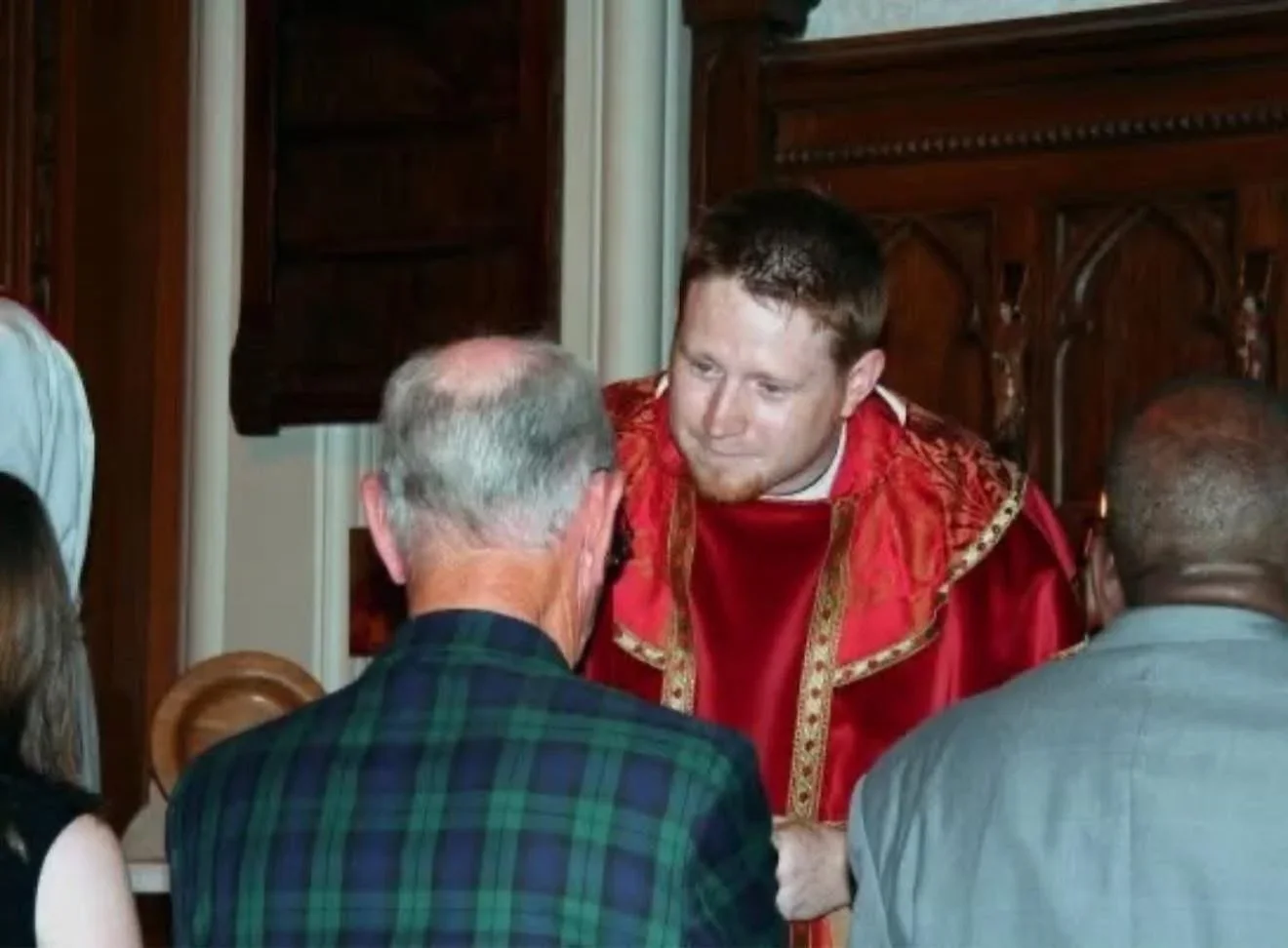
I left Catholicism. In 2006, I became an Anglican. Twenty-five months later, I was ordained a priest.
At ordination, I thought I had been carried beyond history. At forty-five, I understand that I had walked directly into it.
I thought becoming an Anglican priest had reconciled the Protestant inheritance of my father with the Irish Catholic inheritance of my mother—that I had transcended the old division. But part of me also wanted acceptance from an institution my ancestors had every reason to distrust.
I loved people in that church. I believed what I preached. I was not mocking the altar or pretending when I served there.
But sincerity does not make history disappear.
As I wrote in Twenty-Five Months, “I wanted the Church to name me into stability.” I wanted its robes, language and authority to tell me that the conflict inside me had been resolved. Anglican priesthood gave the Glasgow Catholic boy a recognised place inside a tradition formed by the British establishment. It made me respectable.
At my ordination, my Irish Catholic grandfather crossed a denominational boundary and received Communion from me. It remains one of the tenderest acts of love in my life. I do not believe he felt betrayed by me. But, as I later wrote in Ancestral Betrayal, history was sitting silently in the room.
The ancestral betrayal was not that I loved Anglican people, believed Anglican prayers or served Anglican communities. It was believing that admission into that institution had reconciled me with history.
Section 18 is that same logic of conditional belonging written into law. The state admitted Catholics into public life but retained a boundary around the established altar.
I tried to resolve that inherited boundary by crossing it and standing at the altar myself.
Then, in 2018, the Anglican Church deprived me of ministry.
It did not deprive me because I had been born Catholic. That is not my claim.
Two years later, after an appeal went nowhere and legal costs threatened to consume what remained, I chose to stop fighting and relinquished my orders. That decision did not make the loss voluntary. It acknowledged what had already been done.
Leaving Anglicanism itself was different. More recently, I chose to leave the Anglican Church and return to the Church of my baptism as a layman.
I did not leave the Anglican priesthood by choice. I left the Anglican Church by choice.
In 2020 I published Redemptive Trauma: Confession of a Defrocked Priest. I dedicated it “to all those who don’t belong.” I was writing about trauma, institutional power, my own wrongdoing, grace and the possibility that no human being should be reduced to the worst true sentence about them. I was also trying to understand why belonging had carried so much power over me.
Nor is my private loss equivalent to the exclusion of generations. What I recognise is the power of an institution to grant belonging, define its conditions and persuade us that admission is the same thing as freedom.
The 1829 Act did not abolish religious hierarchy. It moved Catholics upward within it while protecting the authority of the established Church. It names the bargain so many institutions offer:
You may belong, provided that those already inside retain the power to define the terms.
White supremacy, sectarianism and class hierarchy are not identical. But they share a grammar. Humanity is arranged into ranks. Some people belong naturally. Others may be admitted conditionally. Others must remain outside so that those just admitted can feel safely inside.
That is how an excluded people can be recruited into exclusion.
In my recent writing about Scotland and empire, I argued that empire often offers a humiliated nation a promotion. You can have a place in the machinery, it says, provided somebody remains beneath you. The Irish story contains colonization, dispossession, hunger, migration and religious contempt. None of that makes Irish people incapable of racism. Suffering does not confer innocence. Sometimes it creates empathy. Sometimes it creates an appetite for admission.
Over time—most visibly in North America—many Irish people gained the privileges of whiteness. Some learned to use those privileges against the people excluded after them.
That distinction matters. Irish history and Black history are not the same. Recognition is not sameness. We do not honour one people’s suffering by borrowing another people’s story, and we do not honour our ancestors by turning their wounds into permission to wound somebody else.
After a recent trip to Dublin, a friend sent me Imelda May performing her poem, “You Don’t Get to Be Racist and Irish.”
The title stayed with me because it sounds impossible and is morally exact.
I wrote back: This is why I became Catholic again. You cannot be Catholic and be racist. Not if you worship a crucified God.
It was morally true. It was not literally true.
Of course Irish people can be racist. The evidence is not difficult to find. In 2024, Ireland’s Central Statistics Office reported that 49 percent of Black Irish, Black African and other Black respondents had experienced discrimination during the previous two years, compared with 19 percent of White Irish respondents.
Catholics can be racist too. Catholics have been racist. Catholic people and institutions have participated in colonialism, segregation and the same anxious hierarchies as everyone else.
Rome is not pure. Returning to it does not make me innocent.
Religious identity is not a character reference.
I recently wrote that Henry VIII went to Mass. Religious practice can become evidence we submit in our own defence. We prayed. We attended. We knew the doctrine. Therefore we must be good.
No.
The Mass is not somewhere to hide from accountability.
So when I say that Catholics do not get to be racist, I do not mean that baptism removes the human capacity for prejudice. I mean that racism is a contradiction of what Catholicism says a human being is. The Catechism says that discrimination based on race, colour, social condition, language or religion must be eradicated as incompatible with God’s design.
Catholic means universal. At the altar, nobody possesses more of the image of God than anybody else. We worship a God revealed not through domination, bloodline or racial purity, but in the rejected Christ. The Cross turns everything on its head. It does not flatter our hierarchies. It exposes them.
Historically, white nativist movements understood at least part of this collision. The Know-Nothings treated Irish and German Catholics as foreign and dangerous. The Ku Klux Klan joined white supremacy to Protestant nativism and antisemitism. Catholic churches and charities were attacked too.
That anti-Catholicism did not prove Catholic innocence. It exposed the supremacist fantasy of a pure nation ruled by the right blood, religion and class.
Catholic immigrants threatened that fantasy because they were foreign, poor, numerous and supposedly loyal to Rome. Yet when Catholics gained acceptance, some accepted the bargain and helped police the next boundary.
That is the temptation Catholic memory must resist.
The Church does not get to point to its persecutors as proof of its innocence. Irish people do not get to display the wounds of empire as an exemption from examining what we have done with whiteness. I do not get to tell the story of what an institution did to me while omitting the harm I caused inside that institution.
Memory becomes moral only when it creates responsibility.
The Roman Catholic Relief Act should be repealed. So should the parallel restriction on Jewish ministers. Not because Catholics or Jews need a special privilege inside the Church of England, but because citizenship should not come in religious grades.
Yet repeal would only remove a legal relic. The deeper work begins after the door opens.
That is the challenge of emancipation.
After liberation comes obligation.
Nearly two hundred years after Parliament offered Catholics relief, Britain has its first professing Catholic Prime Minister. The old law still tells him: you may lead the government, but in this one room you are still not quite one of us.
Catholics should understand the insult. Irish people should remember the bargain. And neither of us gets to demand an equality for ourselves that we are unwilling to extend to somebody else.
You do not get to inherit liberation and deny it to somebody else.