The Giffen Who Never Came Home
I came to Oban as a Giffen on the way home.
I found one who never came home at all.
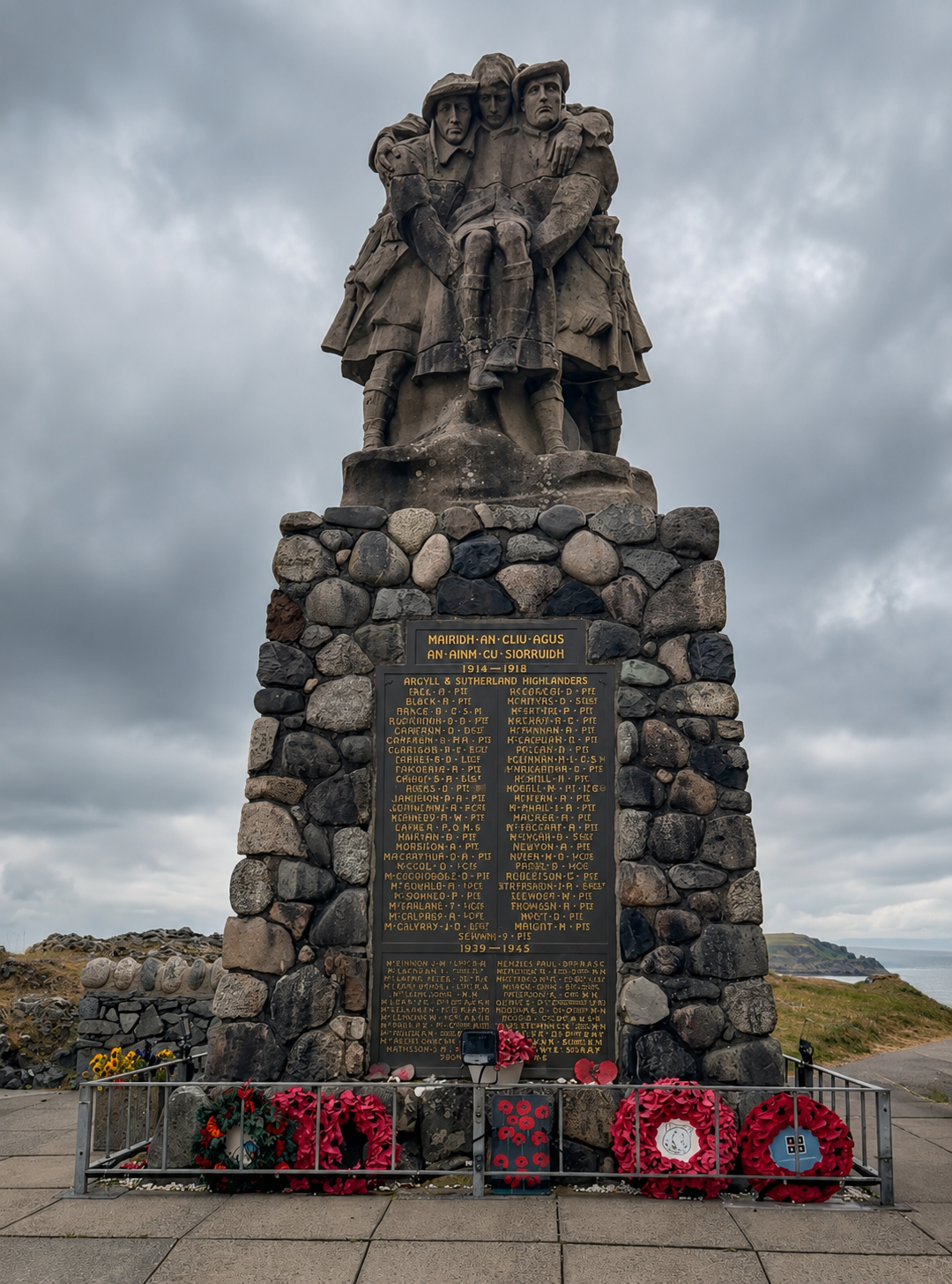
The war memorial stands above Oban Bay at the northern end of the Corran Esplanade. It does not depict a charge, a flag or a victory. It shows two Highland soldiers carrying a wounded third between them—an image of what men carried for one another, and what could not be carried home.
The names are arranged by regiment across all four sides.
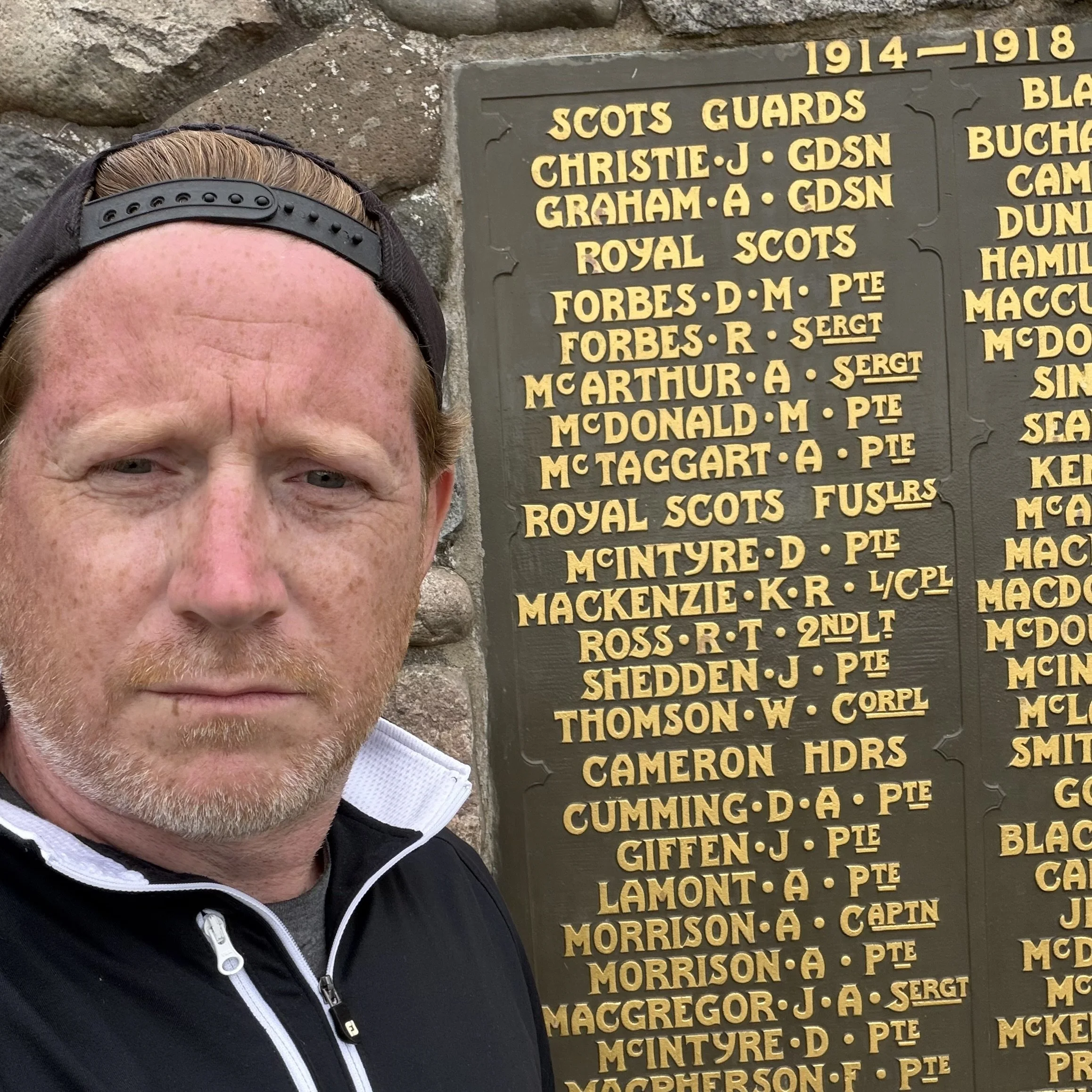
On the rear face, I found the Scots Guards, Royal Scots, Royal Scots Fusiliers and Cameron Highlanders.
Then the name found me.
GIFFEN · J · PTE
I stood beside it and took the photograph.
At first, that was all I had: a surname, an initial and a rank. Enough to stop me, but not enough to know him.
The stone gave me an initial.
The records gave him back his name.
Joseph.
Joseph Giffen was the son of Robert and Jessie Giffen. His father had come to Oban from Strathaven in Lanarkshire and worked as a printer’s compositor.
Joseph was born in Oban.
Oban was home.
He became Private 8334 of the 1st Battalion, Queen’s Own Cameron Highlanders. The battalion landed at Le Havre on 14 August 1914 with the original British Expeditionary Force.
Exactly one month later, the Camerons advanced during the fighting on the Aisne.
The losses were devastating.
Joseph Giffen was among the dead.
He is buried at Vendresse British Cemetery in France: Plot III, Row F, Grave 10.
Britain had been at war for barely six weeks. Joseph had been in France for exactly one month.
His body remained there.
His name came home, carrying back what the war refused to return.
My own Giffen family comes from Falkirk and Camelon. My grandfather was John Giffen. His first wife, my grandmother Elizabeth—Betty—died before I was born, not yet fifty. My father, Ian, carried the name to Canada. More than forty years after leaving Glasgow as a baby, I carried it back across the Atlantic.
That is the line I know.
I do not yet know whether it reaches Joseph.
A shared surname is a clue. It is not a bloodline.
I will not turn a dead man into an ancestor simply because the symmetry pleases me. It would make for a cleaner story, but it would not make it true. The records will decide whether the Giffens of Oban ever meet the Giffens of Falkirk and Camelon.
But Joseph should not have to become my relative before he becomes real.
We often search through the dead looking for ourselves—our family, our clan, our regiment, our country. We care more quickly when we can establish ownership, as though a person must belong to us before we accept any responsibility for remembering them.
Joseph does not exist to prove that I belong in Scotland.
I am the one who arrived late to his story.
Still, the name mattered.
Names are how families cross time. They survive movement, marriage, migration, religion, argument and silence. Sometimes they cross oceans. Sometimes they remain fixed to stone while almost everything else about the person disappears.
Above the names, the memorial makes its promise in Gaelic:
MAIRIDH AN CLIU AGUS AN AINM GU SIORRUIDH
In modern Gaelic orthography:
Mairidh an cliù agus an t-ainm gu sìorraidh.
The renown and the name will endure forever.
Within the memorial, the promise is collective: their renown and their names will endure. Not merely their sacrifice as an idea, but the men themselves, remembered by name.
But names do not endure by themselves.
Someone has to stop. Someone has to read. Someone has to ask who the person was before the letters were cut into stone.
Since returning to Scotland, I have found few clean answers—only ruins, graves, old maps, buried saints, vanished communities and names that survived the people who carried them.
In Oban, one of those names was mine.
Private 8334, Cameron Highlanders.
Born in Oban.
Killed during the fighting on the Aisne on 14 September 1914.
Buried in France.
Remembered above the bay in the town where he was born.
Whether the Oban and Camelon lines ever meet remains unknown. Perhaps the records will answer that.
I came to Oban as a Giffen on the way home. I found the name of one who never came home at all.
I stopped because the name was mine.
I stayed because it was his.
Joseph Giffen.
Giff on the Way Home.