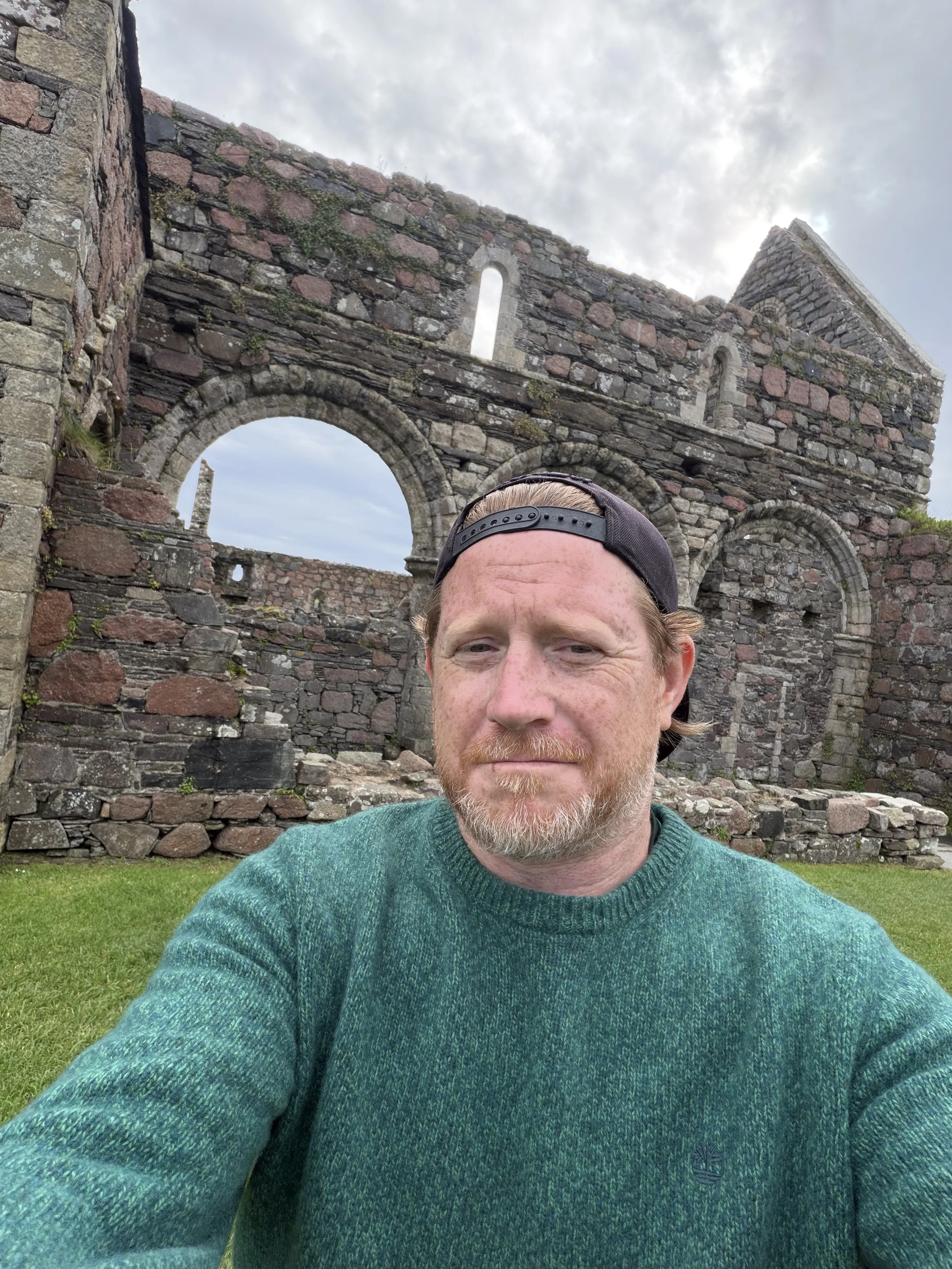
Iona Refuses to Perform
I came to Iona looking for nothing in particular.
No revelation.
No answer.
No sign.
No bargain with God.
I have made enough of those in my life.
I just wanted to go to Iona.
There are places whose names acquire weight long before you ever stand on them. Iona was one of those places for me.
A tiny island off the west coast of Scotland where people have been praying, in one form or another, for almost fifteen centuries.
Columba arrived in 563 with twelve companions and built a community. Others followed.
They prayed. Worked. Argued. Worshipped. Buried their dead. Rebuilt what was broken. Carried on.
Generation after generation came believing that this little island at the edge of the Atlantic mattered.
And then, eventually, I came too.
Not as a priest.
Not carrying some heroic spiritual objective.
Not with a question I expected God to answer before the ferry took me home.
I just wanted to stand there.
There is something about Iona that refuses to perform for you.
We are accustomed to performance. We even do it with faith.
We want breakthroughs. Revelations. Signs. We want God to explain himself. We want suffering to mean something.
Iona offered me none of that.
There was stone.
Wind.
Sea.
Graves.
A table.
A font.
A cross weathered by centuries of Scottish rain.
And beneath the footsteps, conversation and clicking cameras, there was a kind of silence.
Not the absence of noise.
Something older than that.
The kind of silence that puts things back into proportion.
Kingdoms pass.
Arguments pass.
Reputations pass.
Triumphs pass.
Failures pass.
Institutions pass.
The people who praise you pass.
The people who despise you pass.
Eventually, even we pass.
And somehow the prayer continues.
That stayed with me as I walked through the abbey and among the stones.
Across those centuries, people came here carrying the same things we carry now.
Grief.
Fear.
Hope.
Regret.
Children they worried about.
Parents they were losing.
Friends they could not save.
Things they wished they had done differently.
Questions for which there were no satisfying answers.
They stood here.
They prayed here.
They buried their dead here.
Then another generation came.
There is something strangely liberating about realizing how small you are.
Not worthless.
Small.
Those are very different things.
I have been very good at believing that whatever was happening in a particular moment was somehow the entire universe.
An argument becomes the argument.
A failure becomes the failure.
A loss becomes so large that everything else disappears behind it.
Then you stand beside stones that have watched generations come and go.
The argument becomes an argument again.
The failure becomes a failure.
The loss still hurts.
But it is no longer the whole universe.
Sometimes sacred places simply remind you that your questions are older than you are.
I spent years in ministry talking about mystery.
I have spent much of my life demanding explanations.
Sometimes desperately.
Sometimes angrily.
Sometimes wondering whether there was anyone listening at all.
Iona answered none of it.
It did something quieter.
It reminded me that the people who prayed here before me did not understand everything either.
They knew grief and uncertainty.
They knew conflict.
Failure.
Death.
And still they prayed.
There is a temptation to think pilgrimage should end with revelation.
That if you travel somewhere sacred, God owes you clarity.
I received none.
Eventually, I walked back toward the ferry.
The island remained what it had been before I arrived.
Stone.
Wind.
Sea.
Graves.
Prayer.
I came to Iona looking for nothing in particular.
No revelation.
No answer.
No sign.
Only gratitude.
For now, that is enough.
Giff on the Way Home.