The Revenge God Won’t Let Me Have
The Count of Monte Cristo has been my favourite novel for most of my life.
I used to think I knew why.
Edmond Dantès gets out.
After years buried in the Château d’If, betrayed by people he trusted and forgotten by a world that carried on without him, he escapes.
But I don’t think escape is the part that has kept me coming back to the book.
I think it is the return.
Dantès comes back.
That is a different thing entirely.
I am forty-five years old and, after almost a lifetime in Canada, I am back in Scotland.
There has been no treasure.
There is considerably more paperwork than treasure.
I take buses, trains and ferries. I fill in forms. I talk to doctors. I walk ridiculous distances. I try to work out where I am going to live and how I am going to earn money. I sit in churches where nobody needs me to do anything. I make videos, write things, pitch ideas and try to build a life from whatever is still in my hands.
I am home.
Or, at least, I am trying to work out what that word means.
And there remains a part of me that doesn’t merely want a home.
It wants a return.
A proper one.
I want to be healthy.
I want meaningful work again.
I want to write something worth reading.
I want ordinary things with my son that I cannot demand and may have to wait a very long time to receive.
And if I am confessing properly, there is something else.
I want certain people to know.
Not necessarily suffer.
Know.
I want them to hear that I am well.
I want them to stumble across something I have written.
I want the people who decided what I was to discover that their definition didn’t hold.
I want the verdict revised.
That is a much more civilized form of revenge.
It is still revenge.
And Dumas understood it perfectly.
Edmond Dantès begins the novel as a young man with a future he assumes belongs to him.
Work.
Marriage.
Love.
A place in the world.
Then other people intervene.
Jealousy, ambition and cowardice converge, and Dantès disappears into the Château d’If.
Years pass.
The great cruelty is not simply that he is imprisoned.
It is that time does not stop with him.
Everyone else keeps living.
That part of the story means more to me now than it did when I was younger.
I have lived enough life to know that there is rarely one catastrophe.
There are seasons when you think, Surely that was the thing.
That was the collapse.
That was the loss.
That was the event after which I will rebuild.
So you do.
And then life, apparently having misplaced the memo, carries on.
Since I wrote Redemptive Trauma, I have lived an entire other life.
I worked with people dealing with addiction.
I became a mental-health crisis worker.
I sat with people on some of the worst days of their lives.
I worked with people experiencing homelessness, mental illness, poverty, addiction and encounters with the justice system.
I became useful again in ways I had not expected.
I was raising my son.
I built work I believed in.
I made friends.
I lost friends.
I lost one of my oldest and closest friends.
I rebuilt.
And then things broke again.
Some because of what other people did.
Some because systems failed.
Some because my body and brain stopped cooperating.
Some because I made choices that had consequences.
That last category matters.
There is a problem with imagining yourself as Edmond Dantès.
Dantès was innocent.
I wasn’t.
I have been harmed.
I have also caused harm.
I have spent years trying to hold those two truths in the same hand without dropping whichever one is inconvenient that day.
Context does not erase responsibility.
Responsibility does not erase humanity.
I believe both.
I have not always lived as though I did.
That is one reason I read Faria differently now too.
Abbé Faria is the old man Dantès meets inside the prison.
For years I thought his function in the story was obvious.
He gives Dantès the treasure.
He is the doorway to the comeback.
But that is not what Faria does first.
First he helps Dantès understand.
He listens to his story.
He asks questions.
He helps him reconstruct the chain of events that put him inside the Château d’If.
Then he educates him.
Languages.
History.
Politics.
Mathematics.
Human nature.
He cannot simply open the prison door.
So he makes Dantès more capable of living beyond it.
I used to think God’s voice in my life was something like that: a voice in the darkness telling me my story wasn’t finished.
I still believe that.
But I am less interested now in locating one dramatic moment when God spoke.
God has been considerably less tidy than that.
Sometimes the voice has belonged to a therapist.
Sometimes a doctor.
Sometimes a friend who stayed after sensible people might have left.
Sometimes a priest.
Sometimes someone I thought I was supposed to be helping.
I spent years working with people whose entire lives could be reduced, on paper, to a diagnosis, a charge, an eviction, an arrears balance, a substance, a risk assessment or a case note.
The facts on the page might even be true.
They just weren’t the whole person.
That work changed me.
Now I spend a great deal more time on the other side of systems myself.
Forms.
Assessments.
Court documents.
Medical letters.
Applications.
Decisions made by people who know me primarily through what has been written about me.
There is a strange education in that.
A record can be accurate and still be incomplete.
So can a memoir.
So can a grievance.
So can the story you tell yourself about your enemies.
Faria eventually tells Dantès about an enormous treasure.
And almost immediately the possibilities divide.
What good might this do for the people who were faithful?
What harm might it do to the people who were not?
That division is the seed of the Count.
Dantès does not merely escape.
He acquires power.
Money.
Knowledge.
Patience.
Access.
Information.
And then he uses those gifts to settle accounts.
I understand that temptation much better at forty-five than I did at twenty-five.
I have spent a great deal of my life thinking strategically.
Several moves ahead.
Who has power?
Who can be persuaded?
Where is the weakness in the argument?
What document proves the point?
Who needs to see it?
What happens next?
Some of that has made me effective.
Some of it has made me exhausting.
Some of it has helped people.
Some of it has helped me survive.
And some of it has allowed me to convince myself that because I could see an injustice clearly, I was therefore entitled to decide exactly what justice should look like.
That is Dantès’s great mistake.
Eventually, the Count begins to believe he is acting as Providence.
He knows who is guilty.
He believes he knows what justice requires.
The uncomfortable part is that he is right about a great deal.
He was betrayed.
People lied.
People protected themselves.
People profited from his disappearance.
His suffering is not a delusion.
His mistake is not that he sees nothing clearly.
His mistake is believing that seeing something clearly means seeing everything.
Then a child dies.
An innocent person is caught inside the machinery the Count has set in motion.
And Dantès realizes he has crossed a boundary.
He had mistaken moral clarity for omniscience.
Human beings simply don’t know enough to administer perfect vengeance.
We don’t know where the consequences stop.
We don’t know who else will be wounded once we decide the scales must finally be balanced.
Perhaps that is why vengeance belongs to God.
Not because God is particularly enthusiastic about smiting our enemies.
But because we are not qualified to sit in God’s chair.
I find this profoundly inconvenient.
I would still occasionally prefer Thor.
I wrote years ago that there were moments when I wished Jesus behaved more like the God of Thunder.
I understood the appeal of a God who arrived, named the enemy, swung the hammer and won.
I understand it even better now.
Christianity stubbornly gives me Jesus instead.
Not passive.
Not indifferent to injustice.
Not pretending evil is good.
But refusing, at the decisive moment, to become the thing destroying him.
That remains one of the most aggravating things about Jesus.
The problem is that I still want a comeback.
Or at least part of me does.
I want to walk back into the world so completely alive that nobody gets to confuse survival with defeat.
I want the old narratives to become embarrassingly inadequate.
I want to make good things.
I want to be useful.
I want to be a father in whatever ways remain open to me.
I want to belong somewhere without having to audition for it.
Those are not bad desires.
But buried among them is another one.
I want my future to prove my case.
That is the danger.
Because then every good thing becomes evidence.
A successful project becomes Exhibit A.
A healthy relationship becomes Exhibit B.
An audience becomes evidence.
My son becomes evidence.
And he must never become that.
Neither should anybody else.
A human life cannot become a litigation brief against the people who hurt it.
That is not restoration.
It is captivity with better scenery.
Dantès escapes the Château d’If long before the Count of Monte Cristo does.
The prison keeps travelling with him.
His enemies continue arranging his life after they have lost the power to do so.
Every movement is calculated in relation to them.
Every gift is partly a weapon.
Every success still has an audience.
That, I think, is the revenge God may not let me have.
Not the destruction of anyone.
I don’t want that.
Something subtler.
The satisfaction of building a beautiful life and turning around at the end to make sure the right people saw it.
Because if they have to see it, I am still facing backwards.
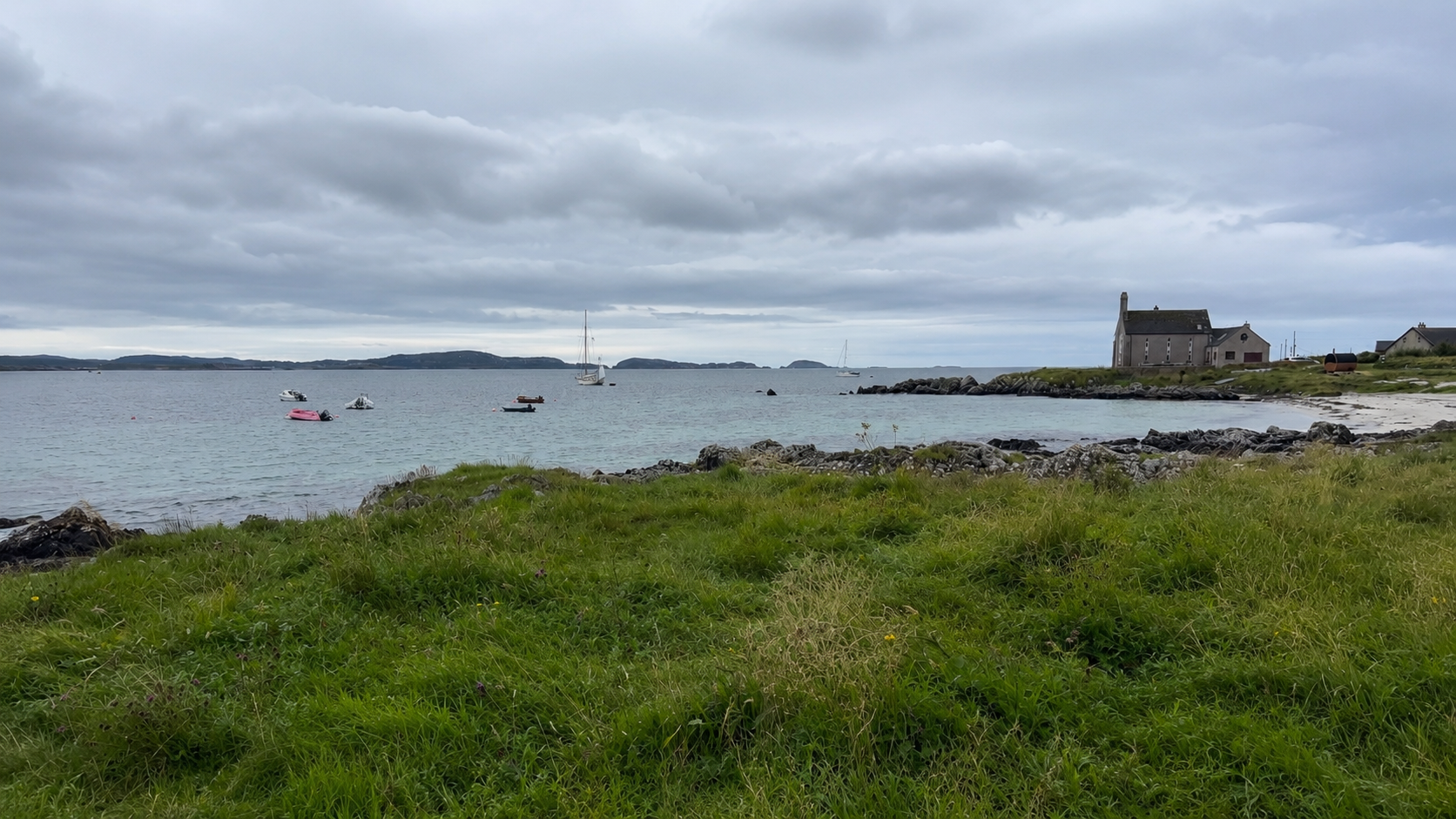
And Scotland has complicated that for me.
I came back here carrying a great many stories about what had been lost.
Instead I keep encountering what is still here.
Land.
Family history.
Churches.
Rain.
Ridiculous bus connections.
People who have been kind to me without requiring a complete explanation first.
A ferry arriving because that is what ferries do, not because God is sending me a sign.
Ordinary life.
I am becoming increasingly suspicious that ordinary life may be the thing I was looking for all along.
Not vindication.
Not restoration of every role.
Certainly not restoration of every relationship.
Some things may return.
Some things should not.
Some things cannot.
That is another truth Dantès eventually has to face.
His revenge cannot give him back the young man who sailed into Marseille.
It cannot return the years.
It cannot simply restore Mercédès and the future he thought was waiting for him.
There are losses so complete that justice cannot make them unhappen.
I know more about that now too.
Which leaves an uncomfortable question.
If I cannot go back and get the old life, what am I building this one for?
That question feels more important to me than revenge now.
More important than proving who was right.
More important even than being understood.
At the end of The Count of Monte Cristo, Dumas leaves us with two words:
Wait and hope.
I have never been particularly gifted at either.
I prefer action.
Arguments.
Plans.
Documents.
A route.
Preferably one with a timetable.
But perhaps I am finally old enough to hear those words without imagining that they guarantee the ending I want.
Wait.
Not everything can be forced.
Hope.
Not everything unfinished is lost.
I am not free of the old calculations.
Some days I still build the argument in my head.
Some days I still imagine the return.
Some days I know exactly who I would like sitting in the audience.
But there are other things to do now.
There is work to find.
There are ordinary days to live.
There are people to know.
There are buses to catch.
There is a son I love from very far away.
There is a country I am learning how to inhabit rather than merely claim.
There is a life here that does not yet know what it is going to become.
I have spent a long time wanting to come back.
I think I am trying to go home.