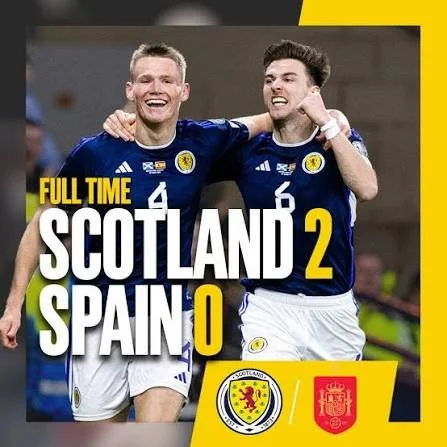
The Last Team to Beat Spain
Spain are world champions.
Again.
They defeated Argentina 1–0 after extra time in New Jersey, completing one of the most formidable international runs football has seen. They conquered Europe in 2024. They crossed the Atlantic in 2026 and conquered the world. Across eight World Cup matches, Spain conceded only once.
And yet, buried beneath the celebrations, there is one glorious fact travelling around Scotland.
The last country to beat Spain outright in a competitive football match was Scotland.
Hampden Park.
28 March 2023.
Scotland 2. Spain 0.
Scott McTominay scored both.
One thousand, two hundred and nine days later, nobody else has managed it.
There are qualifications because football statistics always come with qualifications.
Colombia defeated Spain in a friendly in March 2024. Portugal lifted the 2025 Nations League trophy after winning a penalty shootout, but the match itself is officially recorded as a 2–2 draw after extra time.
But the last team to line up against Spain in a competitive match and simply beat them?
Scotland.
That night at Hampden did not begin as history.
It began as another difficult qualifying match against one of the great powers of European football.
Spain arrived with the pedigree, the players and the expectation. Scotland were supposed to remain organised, survive as long as possible and hope for something from a corner.
Seven minutes into the match, Andy Robertson took advantage of Pedro Porro losing his footing near the Spanish penalty area. Robertson pulled the ball back and McTominay drove it beyond Kepa.
Hampden erupted.
Then, six minutes into the second half, Kieran Tierney tore down the left side and delivered the ball into the Spanish box. It fell again to McTominay.
He struck it cleanly.
Two-nil.
The noise that followed was not merely celebration. It was recognition.
Scotland understood what was happening.
This was not a brave defeat. It was not another evening of glorious failure. It was not a respectable performance against superior opposition that would be remembered fondly after Spain eventually found a way through.
Scotland were beating them.
And Spain knew it.
Afterwards, Spanish captain Rodri criticised Scotland’s approach as “a bit rubbish.” He complained about time-wasting, physical play and Scotland’s willingness to disrupt Spain’s rhythm.
That may be my favourite part.
There is something magnificently Scottish about defeating a footballing empire and then being informed that we had done it incorrectly.
Spain wanted the match played according to Spain’s understanding of football.
Scotland declined.
Scotland did not try to become a lesser version of Spain. They did not ask permission to compete. They made Hampden loud, narrow, physical and deeply uncomfortable.
Spain had most of the ball.
Scotland had the ground.
Possession is not ownership.
In the years that followed, Spain proved exactly how significant that victory had been.
They won the Nations League three months later. They won all seven matches at Euro 2024, defeating England in the final and becoming European champions for a record fourth time. Now they have defeated Argentina and become world champions for the second time.
The Hampden result was not a strange defeat inflicted upon a fading Spanish side.
Scotland beat the team that was about to dominate international football.
That changes the meaning of the night.
I have spent most of my life missing Scotland from somewhere else.
Distance teaches you certain things about this country.
Scotland is extraordinarily good at diminishing itself. We turn victories into jokes before anybody can accuse us of arrogance. We prepare ourselves for disappointment because disappointment feels safer when it has been predicted.
We know the language.
Too small.
Too poor.
Too divided.
Not enough players.
Not enough money.
Not enough belief.
We have been told for generations that the important decisions are made elsewhere. That power lives elsewhere. That culture, opportunity and the future belong to larger countries with greater confidence.
Then, every so often, the world comes to Hampden.
And Scotland refuses the hierarchy.
For ninety minutes, reputation means nothing. Population means nothing. Transfer values mean nothing. The anthem ends, the whistle sounds and the argument must be settled on the grass.
Scotland did not beat Spain because Spain failed to turn up.
Scotland beat Spain because Scotland turned up completely.
Every challenge mattered. Every run mattered. Every voice inside Hampden mattered.
Perhaps that is why the result still resonates.
It was not simply a football score.
It was evidence.
Evidence that small countries are not required to behave like small countries.
Evidence that confidence does not have to be granted by somebody else.
Evidence that there are moments when history stops being something done to Scotland and becomes something Scotland does.
Spain have the World Cup.
They deserve it.
They are European champions, world champions and one of the finest international sides ever assembled.
But when the celebrations are over and the record books are opened, one result remains.
The last outright competitive defeat.
Hampden Park.
Scotland 2.
Spain nil.
Some victories win trophies.
Others become evidence.
Giff on the Way Home.