The Secret That Kept Me Sick
In 2018, while my life was coming apart at the seams, I wrote five words:
Secrets keep people sick.
Two years later, I published a book called Redemptive Trauma: Confession of a Defrocked Priest.
I wrote about drugs. Alcohol. Sex. Infidelity. My marriage. My childhood. My parents. My failures as a priest.
I wrote about lying, manipulation, addiction and broken boundaries. I wrote about the relationship that helped end my ministry.
I called the book a confession.
And I left something out.
I was sexually abused by an Anglican priest.
That is the language I use for it now.
He was a senior archdeacon. Decades older than me. Trusted by senior clergy and bishops. He had been assigned to help mentor me while I was a theological student preparing for ordination.
I was twenty-five.
He was in his seventies.
He touched my backside more than once. Sometimes during embraces. Sometimes in a slap as I walked past. He held me longer than I wanted to be held.
More than once, he kissed my neck.
We never talked about it.
I recoiled. I resisted physically. I communicated discomfort in all the indirect ways people sometimes do when they lack either the confidence or the vocabulary to say what is actually happening.
Then I went back.
Because I loved him.
That is one of the hardest sentences in this story.
I loved him.
Almost twenty years later, when I finally sat down with the person appointed by the Church to investigate my complaint, I said so.
I said I still had fond memories of him.
I said I did not believe he was a bad man.
I meant it.
We prefer abuse stories with monsters.
They are easier.
A monster hurts you. You recognize him. You run. You report him. Somebody intervenes.
Human beings are considerably more complicated than that.
Sometimes somebody can care about you and still cross a sexual boundary with you.
Sometimes the person making you uncomfortable is also somebody whose approval you desperately want.
Sometimes you love them back.
And sometimes you stay.
I stayed.
I also advanced.
I began study in the master of divinity program in 2006. By February 2008, before completing my graduate degree, I had been ordained a deacon.
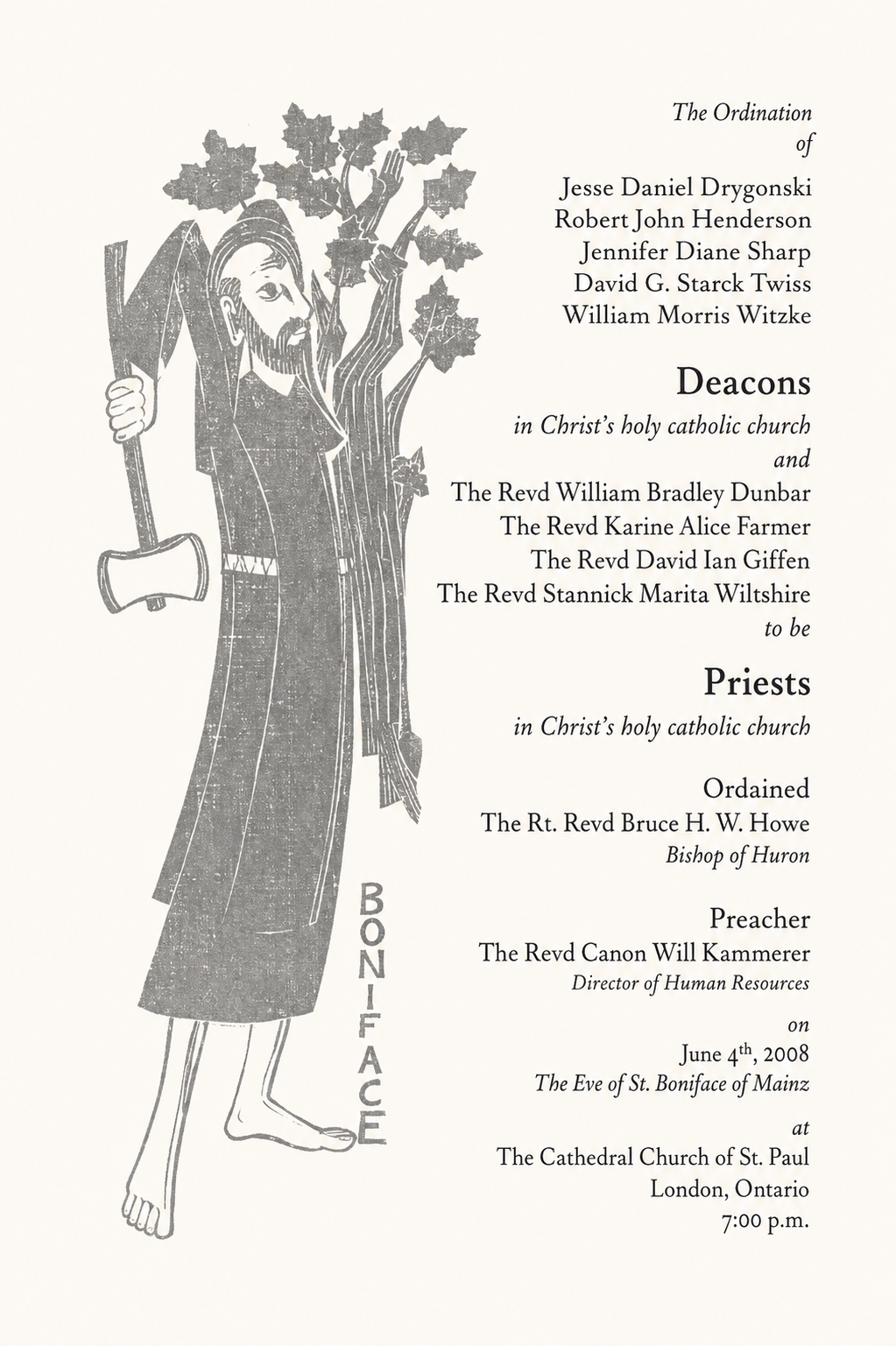
That June I was ordained a priest.
Nearly twenty years later, the investigator asked about the speed of my formation and ordination.
Why had everything happened so quickly?
My answer matters.
I don't know.
I wasn't in all of those rooms.
I have spent years trying to reconstruct them.
I have asked for records. I have asked how decisions were made. I have raised questions about concerns I understood had been expressed by the Faculty of Theology about my readiness and the timing of my ordination.
But there is a line I will not cross.
I cannot prove that I was ordained early because a senior priest was touching me.
I cannot prove that silence was exchanged for advancement.
I cannot tell you what bishops, deans, archdeacons or professors said when I wasn't there.
I can tell you that these things were happening at the same time.
And I can ask the obvious questions.
So can you.
After spending years demanding that institutions tell the truth, I do not get to manufacture the missing pieces of mine.
What I do know is what I did.
I didn't report him.
I stayed.
I accepted the opportunities that came.
I put on the collar.
I became successful.
And in that sense, I benefited from my silence.
I have sometimes used a harsher word.
I have said I profited from it.
I do not mean that somebody bought my silence. I have no evidence of that.
I mean something more ordinary.
I learned that silence worked.
I learned that uncomfortable things could remain unspoken while everybody continued doing their jobs.
I learned that affection, ambition, mentorship, loyalty, intimacy and power could become difficult to separate.
I learned how much could remain unsaid when everybody involved had something to lose.
Eventually, I became very good at living inside that world.
That is harder for me to write than what happened in his office.
Because I did not simply emerge from an unhealthy culture wounded.
I adapted to it.
Some of its habits became mine.
Some of its silences became mine.
And years later, when I became the person with authority, I crossed boundaries myself.
That belongs to me.
Not him.
Not a bishop.
Not the Church.
Me.
I lied.
I manipulated people.
I entered into a secret relationship I had no business entering.
Then I concealed it.
When things began collapsing, I tried to manage people, relationships and information.
When I could no longer control the story, I fought.
Sometimes viciously.
People were hurt.
My family lived through it.
My former wife lived through it.
People I worked with lived through it.
My child has inherited consequences from decisions he had absolutely nothing to do with.
What happened to me gives me no absolution for the boundaries I later crossed with other people.
But what I later did does not erase what happened first.
For years, I thought those were mutually exclusive propositions.
Either I was the victim.
Or I was the perpetrator.
If I could document enough trauma, addiction, psychiatric illness and institutional failure, perhaps responsibility for my own behaviour would eventually disappear.
Or, because I had lied, betrayed people and crossed boundaries myself, perhaps I had forfeited the right to say that anyone had ever crossed one with me.
Both stories are false.
I can have been sexually abused and later violated boundaries myself.
I can have been failed by a Church and still have deserved accountability from that Church.
I can have been psychologically damaged and still be responsible for the ways I damaged others.
I can have been manipulated and later manipulated other people.
I can have been powerless in one room and powerful in another.
Those truths do not cancel each other.
They are the story.
In June 2025, I finally reported what had happened.
The Church investigated.
Five people I identified as potentially having relevant knowledge were interviewed.
Not all of them corroborated me.
That matters.
Some said they had not seen or known of inappropriate conduct.
Others remembered behaviour by this senior priest that the diocesan bishop later said would be considered inappropriate today.
The priest was already dead.
He could not answer my allegation.
He could not give his account.
He could not challenge my memory.
He could not apologize.
There could therefore be no ordinary disciplinary proceeding in which both sides were heard.
That matters too.
I am not going to tell you the Church formally ruled that I had been sexually abused.
It didn't.
But the bishop did write something significant.
He wrote that the priest's actions had harmed me.
He wrote that those actions may have contributed to my mental-health struggles.
Almost twenty years after the events, something that had existed almost entirely inside my memory suddenly existed somewhere else.
On diocesan letterhead.
Something had happened.
It had harmed me.
That acknowledgement did not answer the questions that followed.
Who knew anything at the time?
What concerns had been raised?
What happened to them?
Why did my formation proceed as it did?
Why was I ordained before finishing the degree normally associated with that formation?
Who made those decisions?
What did the people responsible for forming me know about the relationships surrounding that process?
What didn't they know?
What didn't they ask?
Those are questions.
Some remain unanswered.
And unanswered questions are not proof.
I have had to learn that distinction.
Rage hates it.
Rage fills empty spaces.
Rage knows exactly what happened in rooms it never entered.
Evidence doesn't.
I came forward with further complaints.
Some were rejected.
Some authorities disagreed with my interpretation of relationships I believed were inappropriate.
In another case, I was told the person receiving my complaint did not have jurisdiction over the retired cleric involved.
I disagreed with some of those decisions.
I still do.
But there is another part of the record I refuse to conceal simply because it complicates my anger.
When my health collapsed, people inside that same Church helped me.
The Diocese of Huron offered money for therapy.
When my housing became unstable, some of that support was redirected toward keeping me housed.
When I entered psychiatric treatment, clergy wrote to me.
They prayed for me.
A bishop called. When I didn't answer, he called again because he was worried.
So I cannot write the easy version where I am good and the institution is evil.
The evidence will not permit it.
People can fail you terribly and still help you survive.
Sometimes they are the same people.
That makes everything harder.
It also makes it true.
Once I began reconstructing this history, I started remembering what happened when I was the priest people came to.
People brought concerns to me about clergy.
Sometimes I reported them upward.
Sometimes I assumed that telling the next person in authority meant my responsibility had been discharged.
Years later, I went back and asked whether one particular concern I remembered reporting had ever travelled beyond the person I gave it to.
I still don't know.
That does not prove a cover-up.
It means I don't know.
But it leaves me with a question I cannot stop asking:
How many people inside institutions believe they have reported something simply because they told the next person up the ladder?
And what happens after the door closes?
I have also challenged aspects of the investigation that ultimately ended my own clerical career.
The Church's position is that the relationship involved was investigated, that my dishonesty and concealment were considered, and that the matter will not be reopened.
There are things about that process I continue to dispute.
There are also things I will not dispute.
I lied.
I concealed.
I had authority.
I had obligations.
I broke them.
Earlier this year, while making a broader disclosure about Church culture and institutional conduct, I deliberately put something else in writing.
I said I had not exempted myself from scrutiny.
I acknowledged my own compromised involvement.
That may be the most important thing I have said about any of this.
Because I no longer want vindication if vindication requires me to pretend I was innocent.
I wasn't.
I want the whole truth.
And the whole truth is inconvenient.
I once said to another Anglican that it sometimes seemed as though everyone in the Church was fucking everyone and nobody was telling the truth.
Obviously that isn't literally true.
It was rage.
But rage usually has an origin.
Mine came from blurred lines.
Sex.
Power.
Mentorship.
Pastoral care.
Alcohol.
Friendship.
Ambition.
Authority.
Loyalty.
Secrets.
Things people told me.
Things I reported.
Things I assumed somebody else would handle.
People I protected.
People who protected me.
People who later held me accountable.
And somewhere near the beginning was a twenty-five-year-old former Catholic kid who wanted very badly to belong.
The Anglican Church gave me belonging.
Ancient words.
Vestments.
Altars.
History.
A vocation.
A family bigger than my own.
I fell completely in love with it.
What I did not understand was what happens when the place that teaches you belonging also teaches you that some things are easier not to name.
There is a chapter in my book called Boundaries.
In it I wrote:
I am a boundary breaker.
I knew that in 2020.
What I did not understand was that long before I became the senior person crossing boundaries, I had experienced them being crossed from the other side.
That doesn't excuse me.
It explains something.
Those are not the same thing.
I did not understand how badly I wanted powerful older men to love me.
I did not understand how easily mentorship could become intimacy.
I did not understand how loyalty could become silence.
I did not understand how ambition and belonging could become indistinguishable.
And I certainly did not understand how somebody can experience a boundary being crossed while relatively powerless and later cross another boundary once they have power.
I do now.
Maybe that is the anger I never explained.
Not only anger at what happened to me.
Anger that I stayed.
Anger that I loved some of the people who hurt me.
Anger that I learned the system.
Anger that sometimes I protected people and sometimes people protected me.
Anger that I could preach confession while carrying something I could not confess.
Anger that, looking backwards, I still cannot always identify the exact place where survival ended and complicity began.
There is no clean ending to that.
I don't trust clean endings anymore.
I called my book Redemptive Trauma.
I don't think I would call it that today.
Trauma isn't redemptive.
Trauma hurts people.
Sometimes wounded people become extraordinarily compassionate.
Sometimes wounded people wound other people.
Most of us are capable of both.
If redemption means anything to me now, it is not discovering that everything happened for a reason.
It is refusing to make somebody else inherit what happened to you.
It is telling the truth about what was done to you.
Then telling the truth about what you did.
It is taking responsibility for the part that belongs to you without accepting responsibility for the part that doesn't.
It is learning to say I don't know where the evidence stops.
And asking the questions anyway.
In 2018, I wrote that secrets keep people sick.
In 2020, I published a confession while still keeping this one.
Maybe I wasn't ready.
Maybe calling myself abused felt too much like asking to be excused.
Maybe I still needed the story to have heroes and villains.
I don't anymore.
Confession is not an argument for acquittal.
It is telling the truth when the truth refuses to choose a side.
The parts that indict me.
The parts that explain me.
The parts that implicate other people.
The parts that raise questions nobody has answered.
The parts that refuse to make me innocent.
And the parts that refuse to make everybody who hurt me a monster.
Something happened to me before I became the man people eventually judged.
That matters.
What I did afterward matters too.
For years I thought one truth had to defeat the other.
It doesn't.
They can both be true.
And there are still rooms I was never in.
Giff on the Way Home.