Andrew Watson and the Scotland We Keep Forgetting
On 12 March 1881, a Black Scot captained his country to one of the most famous wins in football history.
The result was remembered. The man was not.
On 12 March 1881, Scotland went to London and battered England 6–1 at the Oval. That result still stands as England’s heaviest home defeat, and the man leading Scotland out that day was Andrew Watson, widely recognised as the world’s first Black international footballer.
Sit with that.
Because this is not just a football story. It is a story about memory. About nationhood. About who gets carried proudly in the telling, and who gets dropped quietly through the floorboards.
Andrew Watson was born in British Guiana, the son of a wealthy Scottish father from Orkney and a local woman, Hannah Rose. He came to Britain, found his way into the Scottish game, and became one of the finest players of his era. At Queen’s Park, the most important club in Scotland at the time, he was not there as decoration. He was there because he was good enough. More than good enough. He was elite.
Then Scotland made him captain.
That should be a better-known sentence than it is.
In 1881, a Black man captained Scotland against England in London and led his country to one of the most famous victories in our football history. That is not modern spin. That is not diversity messaging. That is not someone reaching backward to make the past fit the present.
That is simply true.
And yet for far too long, Andrew Watson was treated like a ghost in the story of the game.
That is the part worth paying attention to.
Because forgetting is not always accidental. Sometimes a nation tells the truth about itself selectively. Sometimes it remembers the tartan, the noise, the defiance, the result, the mythology — and somehow loses the man who was standing right at the centre of it. Sometimes we love the story of Scotland more than we love the full truth of Scots.
Watson won only three caps. He never lost one. The scorelines were 6–1, 5–1, and 5–1. Scotland scored sixteen goals and conceded only three in the matches he played. He later broke more ground in the English game as well. By any serious measure, he was not a curiosity. He was not a side note. He was a footballer of consequence.
A pioneer, yes. But more than that, a captain. A winner. A Scot.
And I think that matters now for reasons beyond football.
Because there is always a temptation in national life to pretend identity was once simpler than it really was. Cleaner. Narrower. Safer. There is always someone eager to imply that belonging has a fixed look, a fixed bloodline, a fixed story, and that everyone else arrived later as an amendment.
Andrew Watson wrecks that lie.
He does not stand at the edges of Scottish history asking to be let in. He is already in it. He helped write it.
A Black man led Scotland to glory against England in 1881. That is part of the national story whether anyone is comfortable with it or not. It belongs there. He belongs there.
So no, Andrew Watson should not be remembered as a niche first, a token pioneer, or a heritage-month footnote dusted off for convenience.
He should be remembered properly.
As a great footballer. As Scotland captain. As a man the country had no business forgetting. And as proof that the story of who we are has always been bigger than the small minds trying to shrink it.
Remember his name.
Not because it is fashionable. Because it is overdue.
Andrew Watson.
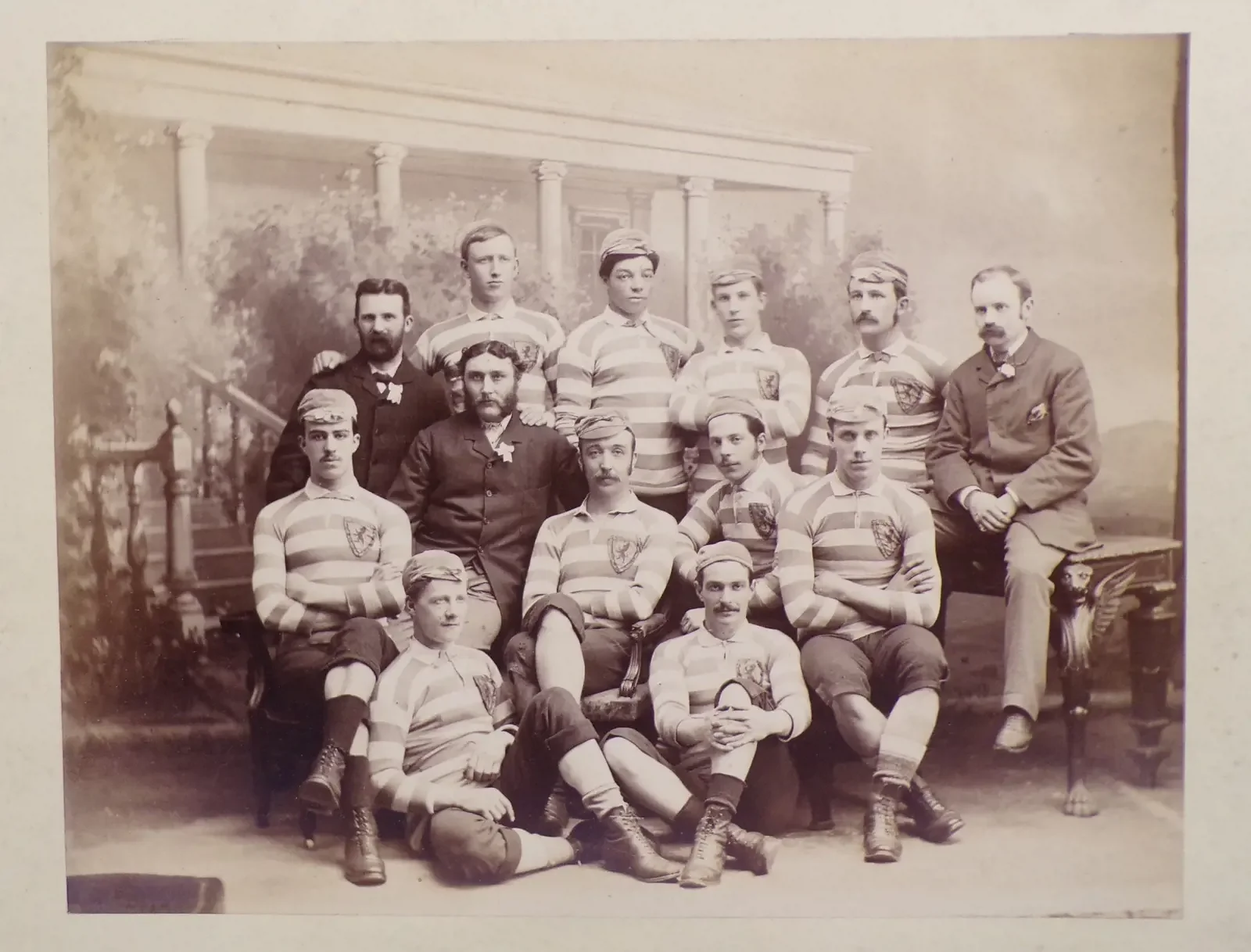
Scotland team photograph, 1881, featuring Andrew Watson. Courtesy of the Scottish Football Museum.